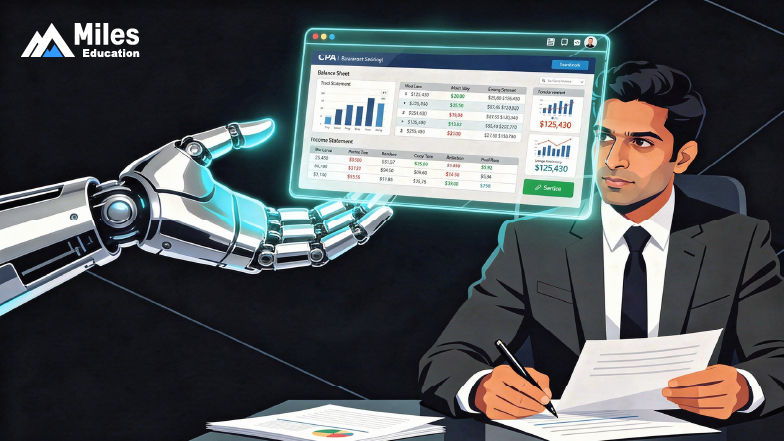
The Heavy Lifting: What AI Handles Today
AI has moved past just being a "nice to have." For most organizations, it is now the engine room of the finance department. Here is where AI accounting tools are doing the heavy lifting:
1. Transaction Processing
Remember the days of manually keying in journal entries? AI now records, categorizes, and posts these transactions instantly. It reduces human error and frees up hours of your day.
2. Invoice & Payables
AI in accounting can read an invoice, match it to a purchase order, validate the amount, and queue it for payment. The "human in the loop" only steps in if there is a mismatch.
3. Bank Reconciliations
Matching bank statements to ledger balances used to be a monthly headache. Now, accounting automation tasks handle 99% of the matches, leaving you to investigate only the 1% of anomalies.
4. Payroll & Compliance
Calculations for statutory deductions and payroll taxes are rule-based, which means AI handles them perfectly. It ensures compliance with changing rates without manual updates.
5. Routine Reporting
Need a trial balance or a P&L statement? You don't need to build it from scratch anymore. AI generates these reports instantly, giving you real-time visibility into financial health.
The Hard Limit: Where Automation Fails
While automation is fast, it isn’t smart in the way humans are. AI in accounting operates within a box. It follows rules and patterns, but it lacks intuition.
- It lacks context: AI sees a drop in revenue, but it doesn't know a competitor just launched a new product.
- It lacks ethics: AI cannot judge if a transaction is "technically legal but ethically wrong."
- It lacks strategy: AI can tell you what happened, but it cannot tell you what to do next.
This gap, "context gap," is where the CPA becomes indispensable.
The New Power Role: Where CPAs Add Value
As automation in accounting takes over the repetitive tasks, the CPA role elevates. You are no longer paid for how fast you can type; you are paid for how well you can think.
- Professional Judgment: Financial standards aren't always black and white. CPAs apply judgment to gray areas that AI simply cannot navigate.
- Strategic Advisory: Instead of spending time fixing spreadsheet errors, you spend time forecasting scenarios and advising leadership on growth strategies.
- Risk & Control: AI systems are only as good as the data fed into them. CPAs design the control frameworks to ensure the AI isn't hallucinating or making processing errors.
- Ethics & Governance: You are the gatekeeper. CPAs validate the outputs of AI accounting tools to ensure accuracy and ethical reporting.
The Future: The "AI-Ready" Accountant
The future isn't "Human vs. AI." It’s "Human + AI."
The accountants who will thrive in the next decade are the ones who know how to drive the machine. This is why credentials like CAIRA (Certified AI-Ready Accountant) are becoming critical.
CAIRA isn't about learning to code; it’s about learning to apply AI to finance. It equips you with the practical skills to:
- Navigate AI accounting tools.
- Interpret automated insights.
- Work confidently alongside intelligent systems.
With these skills, you stop worrying about automation taking your job and start using it to build a better career.
Frequently Asked Questions
1. What are the most common AI tasks in accounting?
Think of the boring stuff: data entry, categorising transactions, processing invoices, and matching bank transactions. These are perfect for accounting process automation because they are repetitive and rule-based.
2. How does automation benefit accountants?
It buys you time. By reducing manual grunt work, automation in accounting clears your schedule so you can focus on high-value work like analysis, strategy, and reviewing complex accounts.
3. Will AI replace CPAs?
No. Accounting tasks replaced by AI are the low-level execution tasks (like bookkeeping). The core values of a CPA judgment, ethics, and strategy cannot be coded into software.
4. How is AI used for bookkeeping?
AI for bookkeeping acts like a 24/7 assistant. It automatically records transactions from bank feeds, categorizes expenses based on past behavior, and flags anything that looks weird for you to review.
5. What skills do I need for the future of accounting?
Beyond debits and credits, you need "tech-savviness." Understanding how automated accounting workflows function and having the ability to analyze AI-generated data are now essential skills for any modern accountant.