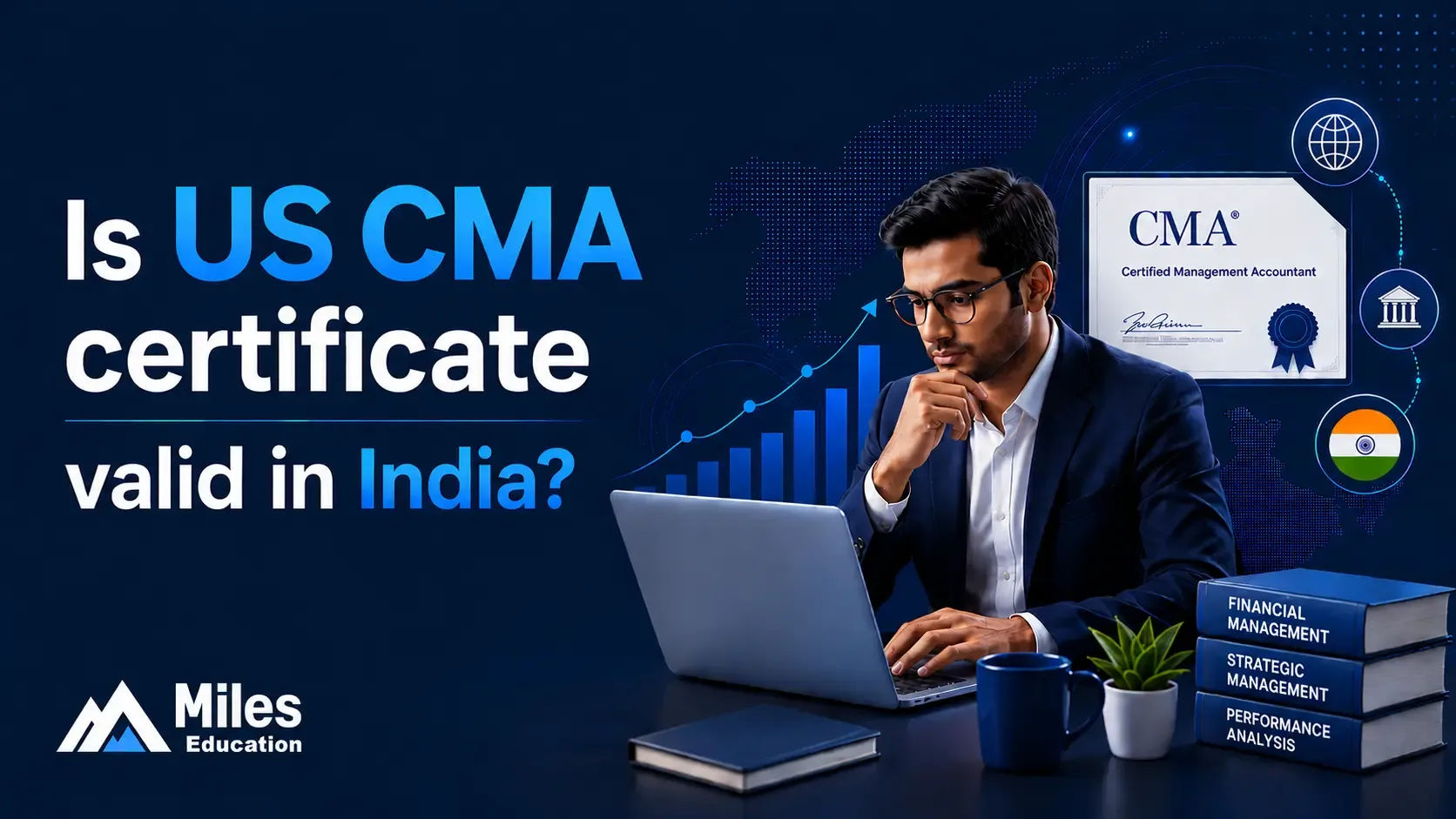
If you are weighing up a global finance qualification, one question comes up again and again: is the US CMA certificate valid in India? It's a fair thing to ask before investing months of study and a meaningful sum of money. The short version is yes - but "valid" means something specific, and understanding that nuance will help you decide whether the US CMA is the right move for your career.
This guide breaks down exactly what recognition the US CMA carries in India, why Indian employers value it, and the full CMA course details you need - from eligibility and syllabus to the exam pattern and fees.
The short answer
The US CMA certificate is recognised across roughly 150 countries, including India, and is awarded by the Institute of Management Accountants (IMA), USA. In India, it is widely respected and actively sought after by multinational companies, Global Capability Centres (GCCs), the Big 4, and large domestic corporates for roles in management accounting, financial planning and analysis (FP&A), and corporate finance.
What it is not is a statutory licence in India. The US CMA does not, by itself, authorise you to sign statutory audit reports (a function reserved for Chartered Accountants under ICAI) or to conduct cost audits (reserved for Cost & Management Accountants under ICMAI). For the vast majority of corporate finance careers, though, that distinction rarely matters - employers hire CMAs for their skills, not for a regulatory signature. More on this below.
What is CMA?
Before the validity question, it helps to be clear on what the credential actually is, because the full form of CMA depends on which country you mean.
- In the US, the US CMA full form is Certified Management Accountant, a credential issued by the IMA.
- In India, the CMA full form is Cost and Management Accountant, administered by the Institute of Cost Accountants of India (ICMAI).
So when people ask what is CMA or what is the CMA course, the honest answer is: it depends on the route. This blog focuses on the US CMA .
In simple terms, the CMA meaning comes down to this: a Certified Management Accountant is a finance professional trained to look forward, not just backward. Where traditional accounting records what already happened, a CMA focuses on planning, budgeting, performance analysis, cost control, risk management, and the strategic decisions that drive a business. That forward-looking, decision-support focus is exactly why the US CMA course has become so popular with Indian students and working professionals chasing global roles.
What does "valid in India" actually mean?
This is the heart of the matter, so it's worth being precise. There are two very different ideas hiding inside the word "valid":
1. Statutory / regulatory validity - the legal right to perform reserved functions. In India, signing a company's statutory audit report is reserved for members of ICAI (Chartered Accountants), and cost audit is reserved for members of ICMAI. No foreign credential, including the US CMA, grants these specific rights. This is true of most professional certifications worldwide; it is about local law, not about the quality of the qualification.
2. Professional and employment validity - whether employers recognise, value, and hire on the strength of the credential. Here, the US CMA is on very strong ground in India. It is a globally portable certification that hiring managers immediately understand, and it signals capability in precisely the areas modern finance teams are short on.
For almost everyone pursuing a US CMA in India - students entering the workforce, accountants moving into FP&A, professionals targeting MNCs or roles abroad - it is the second kind of validity that counts. And on that measure, the US CMA certificate is not just valid; it's an asset.
Why the US CMA certificate carries weight with Indian employers
India has become one of the world's largest hubs for finance and accounting work. Multinationals have set up GCCs and shared-service centres that handle global finance operations from cities like Bengaluru, Hyderabad, Pune, Gurugram, and Chennai. These centres need professionals who understand international management accounting standards, analytics, and strategic finance - and that is the US CMA's home turf.
Employers that actively recruit US CMAs in India include the Big 4 (Deloitte, EY, KPMG, PwC) and other global firms, along with large corporates and GCCs operated by companies such as Accenture, Genpact, JP Morgan, and many Fortune 500 finance teams. Beyond hiring, the qualification often translates into stronger pay: at multinational employers in particular, US CMAs frequently command a noticeable salary premium over non-certified peers, thanks to the credential's global recognition and the skill set it represents.
It's also worth noting the practical advantages that make the CMA USA course attractive to Indian candidates: it has just two exam parts (versus the multi-level Indian route), and it can realistically be completed in around 6 to 12 months of focused study - a fast, high-return path into global finance roles.
US CMA vs Indian CMA: a quick comparison
Because the names are nearly identical, candidates constantly mix up the two. Here's how the CMA US and Indian CMA differ on the points that matter most:
Factor | US CMA (Certified Management Accountant) | Indian CMA (Cost & Management Accountant) |
|---|---|---|
| Awarding body | Institute of Management Accountants (IMA), USA | Institute of Cost Accountants of India (ICMAI) |
| Recognition | Global - recognized in ~150 countries | Primarily India (with some Middle East scope) |
| Focus | Management accounting, FP&A, strategy, analytics | Cost accounting, costing, statutory cost audit |
| Structure | 2 parts | 3 levels (Foundation, Intermediate, Final) |
| Typical duration | ~6–12 months | ~3–4 years |
| Best for | Global roles, MNCs, GCCs, FP&A, corporate finance | Domestic industry, manufacturing, PSUs, cost audit |
Neither is "better" in the absolute - they serve different goals. If your ambitions are international or MNC-focused, the US CMA is usually the stronger fit. If you are targeting Indian statutory cost-audit roles or domestic manufacturing/PSU careers, the Indian CMA has the edge.
US CMA course details: eligibility, syllabus, exam, and fees
Here are the US CMA course details every aspiring candidate should know before they begin.
CMA eligibility
The CMA eligibility requirements are refreshingly straightforward and designed to be accessible to both students and working professionals. To earn the certification, you need to satisfy three pillars - education, examination, and experience:
- Education: A bachelor's degree in any discipline from an accredited institution, or a recognised professional qualification (such as Indian CA, CS, or Indian CMA). Students can register and begin studying even before they graduate.
- Membership: An active IMA membership, which must be maintained throughout the program.
- Examination: Pass both Part 1 and Part 2 of the CMA exam (both must be completed within three years of entering the program).
- Experience: Two continuous years of professional experience in management accounting or financial management. Helpfully, this can be completed before the exams or within seven years after passing them - so a lack of experience never stops you from starting.
US CMA syllabus and exam
The US CMA syllabus is built by the IMA around its Content Specification Outlines and is split into two parts, with six topic areas in each. The CMA USA syllabus looks like this:
- Part 1 - Financial Planning, Performance, and Analytics: external financial reporting decisions; planning, budgeting and forecasting; performance management; cost management; internal controls; and technology and analytics.
- Part 2 - Strategic Financial Management: financial statement analysis; corporate finance; decision analysis; risk management; investment decisions; and professional ethics.
In terms of the CMA exam format, each part runs for four hours and has historically combined 100 multiple-choice questions with a written/scenario section. The scaled passing score is 360 out of 500 per part.
A 2026 update is reshaping how that second section is tested: the IMA is moving from traditional essays to Case-Based Questions (CBQs) - scenario-driven tasks that test application rather than rote writing - phased in through 2026. The refreshed exam also places a heavier emphasis on technology and data analytics, reflecting how the profession itself is changing (a theme we return to below). Because details like topic weightings and format evolve, always confirm the current blueprint on the IMA's official site (imanet.org) before you start studying.
US CMA course fees
The CMA USA course fees consist of mandatory fees paid directly to the Institute of Management Accountants (IMA) and optional expenses such as coaching and review materials. Eligible students receive significant discounts compared to working professionals.
Professional candidates pay an annual IMA membership fee of $295, a one-time CMA entrance fee of $300, and $545 per exam part (two parts).
Student candidates pay an annual IMA membership fee of $49, a one-time CMA entrance fee of $225, and $407 per exam part.
Based on current exchange rates, the mandatory IMA fees generally amount to around ₹1 lakh for students and ₹1.5-1.7 lakh for professionals. Including coaching, study materials, and mock exams, the overall investment typically ranges between ₹1.5 lakh and ₹2.5 lakh. Since IMA periodically revises its pricing and exchange rates fluctuate, candidates should always verify the latest fee schedule on the official IMA website before registering.
CMA registration
CMA registration is handled online through the IMA. The sequence is simple: become an IMA member, pay the one-time CMA entrance fee (valid for three years), and then register and schedule each exam part at a Prometric test centre. The entrance fee is paid once; membership is renewed annually until you've cleared both parts and earned the credential.
The 2026 reality: AI is rewriting the accountant's job
You can't discuss the value of any finance qualification in 2026 without talking about artificial intelligence - and this is where the US CMA's forward-looking design really pays off.
The shift has been dramatic. Industry research in 2026 points to near-universal adoption: surveys such as the State of AI in Accounting report suggest well over 90% of accounting professionals globally now use AI in some form, and a 2026 CFO study found that around 97% of finance departments have adopted AI, up from roughly 76% just a year earlier. The most common use cases are practical, everyday ones - knowledge management, accounts-payable automation, and error or anomaly detection. Looking ahead, Deloitte research found that a large majority of finance leaders expect AI to automate more than half of routine accounting work.
Here's the crucial part for your career decision: the evidence overwhelmingly points to augmentation, not replacement. AI is automating the repetitive production work - data entry, reconciliations, first-draft reporting - and pushing human accountants up the value chain into judgement, analysis, exception-handling, and advisory work. The professionals who thrive will be the ones who pair solid technical fundamentals with the ability to actually use these tools.
That is precisely why the US CMA holds up so well. Its syllabus already centers on the higher-order skills AI can't replicate - strategic financial management, decision analysis, risk, and analytics - and the 2026 exam updates lean even further into technology and data. A credential built around judgement and analytics is exactly the kind of qualification that gets more valuable as routine work gets automated, not less. The one gap it doesn't fully close on its own is hands-on fluency with the AI tools now standard in finance teams - and that's a gap worth closing deliberately.
Preparing the smart way
Clearing two rigorous papers in 6–12 months is very achievable, but most successful candidates don't do it alone. Choosing an IMA-approved learning partner gives you structured content, mentoring, mock exams, and - often - discounts on the IMA fees themselves.
This is where Miles Education is worth knowing about. As an IMA Platinum Partner, Miles has trained finance professionals for the US CPA and US CMA since 2014, and is led by Varun Jain (CPA, CMA, and a Harvard Business School alumnus). Beyond exam prep, it's built an ecosystem around placements with the Big 4, MNCs, and GCCs, with a presence across 20+ Indian cities and the Miles One app for learning on the go.
Miles has also moved early on the AI question with CAIRA - the Certified AI-Ready Accountant credential. Designed to sit alongside a CPA or CMA as the "AI capability layer," CAIRA is a three-level, NASBA-approved CPE program of around 90 hours that teaches accountants to apply the Microsoft AI stack - Copilot, Power BI, Power Automate, and Copilot Studio - across real audit, tax, close, and FP&A workflows. Given how quickly AI fluency is becoming a baseline expectation in finance teams, pairing the analytical rigor of the US CMA with practical AI skills is a genuinely future-proof combination - and CAIRA Level 1 is currently offered free to Miles CPA/CMA candidates.
Final verdict: yes, the US CMA is valid - and valuable - in India
So, is the US CMA certificate valid in India? Yes. It is a globally recognised, IMA-issued credential that Indian employers - especially MNCs, GCCs, and the Big 4 - actively value and hire for. It does not replace the statutory roles of an Indian CA or ICMAI CMA, but for the overwhelming majority of corporate finance and management accounting careers, that's beside the point.
In an era where AI is reshaping the profession and analytical, decision-focused skills are at a premium, the US CMA is arguably better positioned than ever. Pair it with deliberate AI upskilling, and you have a credential set that's built not just for today's job market, but for where finance is heading.
Frequently asked questions
1.Is CMA USA recognised by the Indian government?
The US CMA is a professional certification recognised and valued by employers in India, but it is not a statutory licence under Indian law. Functions like statutory audit (ICAI) and cost audit (ICMAI) remain reserved for the respective Indian bodies. For corporate finance and management accounting roles, the US CMA is widely accepted.
2. How long does the US CMA course take?
Most candidates complete both parts in around 6 to 12 months with consistent study - far quicker than the multi-year Indian CMA route.
3.Can I do the US CMA after the Indian CMA, CA, or as a graduate?
Yes. A bachelor's degree in any field, or a professional qualification such as CA, CS, or Indian CMA, satisfies the education requirement. Students can even begin before graduating.
4.What are the total US CMA course fees in India?
Mandatory IMA fees plus coaching typically land in the ₹1.3–2 lakh range, with students paying less than professionals. Always confirm current IMA fees at the time of registration.
5. Does the US CMA help with jobs in AI-driven finance teams?
Yes - its focus on analytics, strategy, and decision-making aligns well with where finance roles are heading. Combining it with hands-on AI skills (for example, through a credential like CAIRA) makes the profile even stronger.