Finance automation is the programmatic deployment of artificial intelligence, cloud architectures, and machine learning to execute complex financial workflows with minimal manual intervention. It transforms traditional bookkeeping into an autonomous engine, handling journal entries, account reconciliations, variance diagnostics, and regulatory filings in real time.
In 2026, India is home to approximately 50% of the world’s Global Capability Centers (GCCs), making it one of the largest global hubs for enterprise capability and shared-service operations . For these enterprise hubs and ambitious mid-size firms, deploying finance automation is no longer a luxury pilot program. It is an operational necessity required to survive acute cross-border compliance demands and rising transaction volumes.
Manual month-end consolidations, error-prone spreadsheet macros, and siloed transaction entry are fundamentally obsolete. Corporate controllers and CFOs demand real-time visibility into liquidity, predictive working capital metrics, and automated audit trails.
This comprehensive 2026 guide provides an executive-level roadmap for corporate leaders and accounting professionals. We examine core deployment phases, highlight the top software stacks, evaluate emerging career opportunities, and explore how automation reshapes modern finance.
The Paradigm Shift: Understanding Automation in Finance
To deploy modern systems successfully, enterprise leaders must first evaluate how automation in finance has evolved over recent operating cycles. Historically, shared services relied on rigid Robotic Process Automation (RPA) bots. These early scripts merely copied and pasted data across screens, breaking instantly whenever an ERP interface updated.
Today, modern financial automation operates on intelligent cognitive workflows. Advanced platforms ingest unstructured vendor invoices, interpret dynamic contractual clauses, and reconcile multi-currency banking feeds autonomously.
This rapid maturity redefines financial process automation across core operational cycles:
Procure-to-Pay (P2P): Machine vision systems extract two-way and three-way invoice matches, routing exceptions directly to operational managers via automated approvals.
Order-to-Cash (O2C): Algorithmic credit scoring updates customer credit limits dynamically, generating recurring invoices and matching incoming cash receipts against open receivables.
Record-to-Report (R2R): Continuous transaction matching replaces the stressful month-end rush, auto-clearing intercompany accounts and posting recurring accruals seamlessly.
Transitioning toward intelligent workflows allows corporate finance teams to discard repetitive administrative tasks. Professionals can redirect their mental bandwidth toward capital allocation, tax structuring, and strategic enterprise growth.
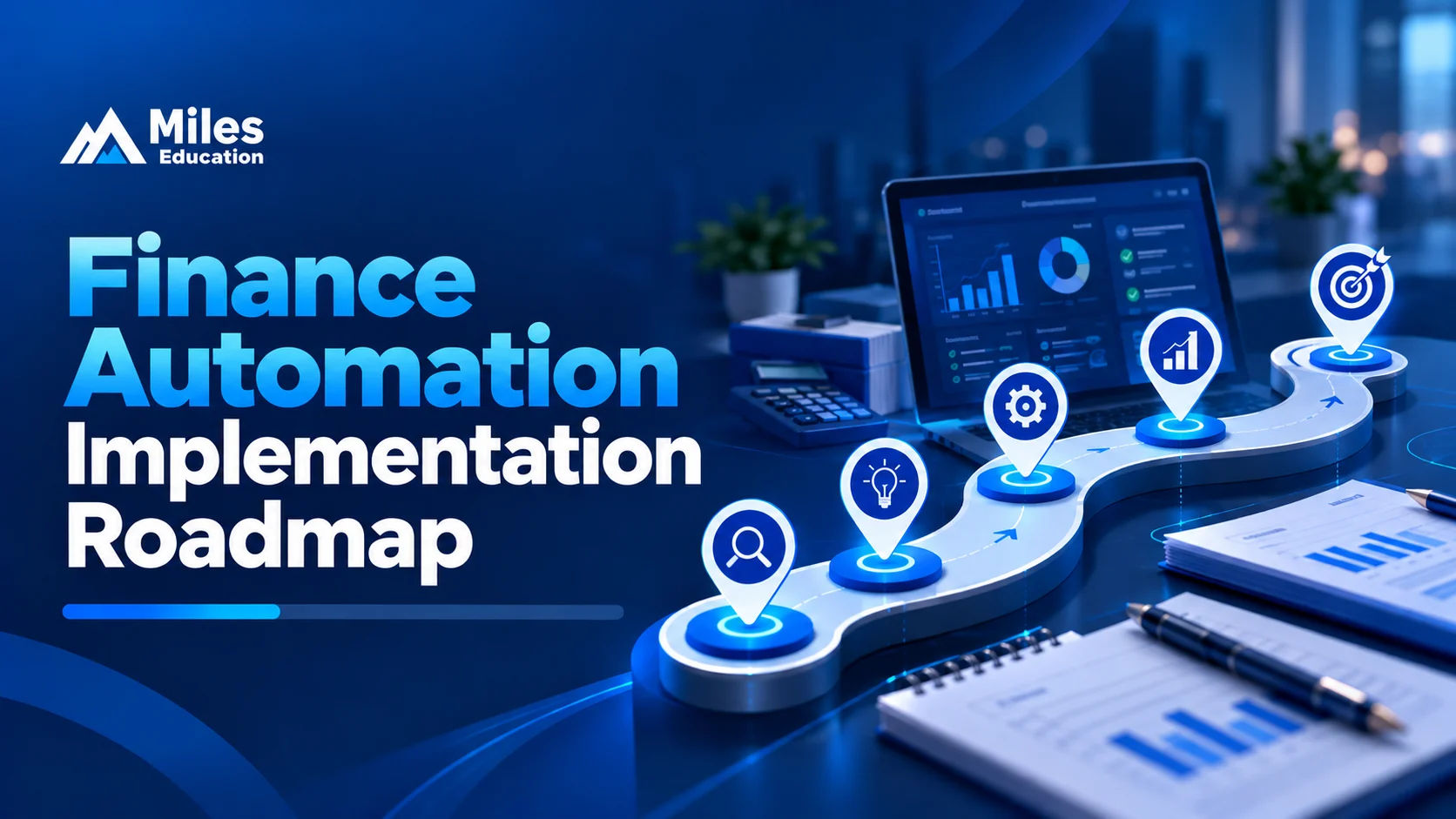
The 5-Phase Finance Automation Implementation Roadmap
Deploying automation across an enterprise requires a disciplined framework. Rushing into software purchases without cleaning underlying processes guarantees implementation failure.
Indian GCCs and mid-market organizations must follow this structured five-phase roadmap to maximize operational return on investment.
Phase 1: Process Standardization and the Foundations of Finance
Automating an inefficient process merely produces faster errors. Before writing code or buying licenses, leadership must audit existing financial workflows thoroughly.
Teams must reinforce the foundations of finance by harmonizing charts of accounts across parent companies and overseas subsidiaries. Standardize transaction approval hierarchies, eliminate duplicate vendor entries, and document every manual spreadsheet adjustment. Establishing clean baseline data ensures that downstream algorithmic processing runs without systemic errors.
Phase 2: System Architecture and Finance Automation Tools Selection
Once workflows are standardized, systems architects must design a secure, interconnected technology layer. Modern architectures reject isolated legacy software in favor of open API connectivity.
Organizations must select specialized finance automation tools that communicate seamlessly with core Enterprise Resource Planning (ERP) systems like SAP S/4HANA, Oracle NetSuite, or Microsoft Dynamics 365. The objective is establishing straight-through data processing from initial customer payment gateways directly into the general ledger.
Phase 3: Integrating Financial Close Automation Software
The traditional month-end close represents the biggest source of burnout for corporate accountants. Phase 3 focuses entirely on deploying dedicated financial close automation software.
Platforms like BlackLine, FloQast, and Trintech connect directly to enterprise databases to verify high-volume balance sheet accounts automatically. When cash balances match bank statements within predefined tolerance limits, the software marks the account reconciled instantly. Accounting teams only step in to review flagged outliers, compressing the close cycle from ten days down to forty-eight hours.
Phase 4: Deploying Financial Reporting Automation Tools
With reconciliations running continuously, organizations must automate regulatory and management disclosures. Waiting weeks for statutory report compilation destroys executive agility.
Deploying advanced financial reporting automation tools enables continuous consolidation across global business units. Platforms like Workiva and Fluence Technologies combine balance sheet inputs with SEC reporting taxonomies. Meanwhile, business intelligence platforms like Power BI generate real-time management board decks with automated narrative commentaries, eliminating manual slide deck construction.
Phase 5: Internal Governance, Algorithmic Audits, and Change Management
The final phase establishes robust governance over automated systems. Automating journal entries introduces new internal control risks that must be documented carefully for external auditors.
Finance leaders must configure strict segregation of duties (SoD), encrypt data in transit, and establish periodic model validations. Furthermore, leadership must invest heavily in workforce transition programs. Upskilling domestic accounting staff to oversee automated platforms ensures long-term operational adoption and cross-functional success.
Enterprise Technology Matrix: Core Tools in 2026
Building a modern corporate tech stack requires selecting tools tailored to specific operational hurdles. Indian GCCs integrate specialized solutions to manage end-to-end accounting processes:
Operational Discipline | Primary Automation Objective | Leading Enterprise Platforms | Key Business Impact |
|---|---|---|---|
Balance Sheet Reconciliation | Auto-match high-volume transactions | BlackLine, Trintech Cadency | Eliminates 80% of manual close tick-and-tie |
Close Task Management | Track month-end close checklists | FloQast, ServiceNow Finance | Provides real-time visibility into bottlenecks |
Accounts Payable (AP) | Ingest invoices, automate 3-way matching | Tipalti, Stampli, Basware | Slashes invoice processing costs by up to 70% |
FP&A & Variance Modeling | Continuous rolling forecasts & scenarios | Vena, Datarails, Planful | Delivers instant predictive cash runaways |
Statutory & ESG Reporting | Multi-jurisdiction financial disclosures | Workiva, Certent | Ensures error-free US GAAP and SEC reporting |
Implementing these targeted applications creates a cohesive enterprise ecosystem. Routine journal entries update instantly, leaving human teams free to address complex tax scenarios and commercial advisory.
The Talent Landscape: Salaries and Finance Automation Jobs
The rapid expansion of automated architectures has permanently altered hiring across Indian capability centers. Basic transaction processors and manual data-entry clerks face declining career prospects. Conversely, the market for certified professionals who can design, manage, and audit automated ecosystems is surging.
Demand for finance automation jobs has outpaced traditional accounting vacancies across major metropolitan centers like Bengaluru, Hyderabad, Gurugram, and Pune. International enterprises actively recruit hybrid professionals who possess both prestigious accounting credentials (such as the US CPA or US CMA) and technical systems fluency.
Understanding compensation trends reveals how aggressively the corporate market rewards automation proficiency:
Professional Career Stage | Target Corporate Role | Primary Technical Competencies | 2026 Average Salary (India GCCs) |
|---|---|---|---|
Associate (0–2 Years) | Finance Automation Analyst | API data extraction, Power Query, basic reconciliations | ₹8.5 Lakhs – ₹13.0 Lakhs |
Senior Specialist (3–6 Years) | Financial Systems Senior | BlackLine integration, SQL, US GAAP compliance | ₹15.0 Lakhs – ₹24.0 Lakhs |
Manager (7–10 Years) | Global Close & Automation Lead | SOX controls design, ERP migration, workflow design | ₹26.0 Lakhs – ₹42.0 Lakhs |
Director / Head (10+ Years) | VP of Finance Transformation | Enterprise architecture, strategic capital planning | ₹50.0 Lakhs – ₹90.0 Lakhs+ |
These compensation benchmarks confirm that mastering automated enterprise frameworks unlocks immediate professional advancement and substantial earnings growth.
Lead the Future of Finance Transformation with Miles Education
Bridging the gap between traditional debit-and-credit accounting and advanced enterprise automation requires structured, future-facing professional training. Attempting to manage modern corporate finance using outdated college textbooks leaves professionals unprepared for the technological expectations of global employers.
At Miles Education, we build world-class, future-ready financial leaders. Led by industry expert Varun Jain, Miles is the undisputed market leader in US CPA and US CMA training across India. We proudly train over 80% of all working US CPAs and CMAs in the country, supporting an active global alumni community exceeding 70,000 professionals across Big 4 firms and Fortune 500 GCCs.
To prepare accountants for automated enterprise environments, Miles offers the proprietary Certified AI-Ready Accountant (CAIRA) program. You will master generative AI tools, automated audit sampling, Microsoft Copilot integration, and predictive data analytics alongside your core accounting studies. You do not just learn to record transactions; you learn to architect the automated systems that govern them.
Furthermore, for ambitious candidates targeting international careers in North America, our exclusive Miles US Pathway provides an unmatched route. We seamlessly place qualified candidates into premier STEM-designated master's degree programs at leading American universities. This pathway legally secures up to three years of post-study OPT work authorization, allowing you to bypass the uncertain H-1B lottery system entirely. Eligible F-1 students may qualify for post-completion OPT and, for qualifying STEM degrees and employers, may apply for a 24-month STEM OPT extension, potentially providing up to 36 months of work authorization.
The era of manual corporate bookkeeping is over. Lead the technological transition rather than being displaced by it. Partner with elite digital mentors at Miles Education, master the tools driving modern accounting, and confidently secure your place at the forefront of global corporate finance in 2026.
Frequently Asked Questions (FAQs)
1. What is finance automation and how does it help Indian GCCs?
Finance automation is the programmatic deployment of software, machine learning, and cloud tools to execute core financial workflows autonomously. In Indian GCCs, it eliminates manual processing bottlenecks across accounts payable, reconciliations, and financial close cycles, enabling seamless management of massive global workloads.
2. What are the best financial close automation software platforms in 2026?
The leading financial close automation software platforms include BlackLine, FloQast, and Trintech Cadency. These enterprise tools integrate directly with core ERP systems to auto-reconcile balance sheet accounts, streamline intercompany eliminations, and provide collaborative dashboards that cut close timelines by over 50%.
3. How does automation in finance impact traditional accounting roles?
Deploying automation in finance eliminates manual data entry, physical paper sorting, and routine ledger balancing. Rather than eliminating accountants, it elevates their responsibilities toward system governance, anomaly resolution, algorithmic auditing, and forward-looking strategic commercial advisory.
4. What are the key financial reporting automation tools used by multinational firms?
Top financial reporting automation tools include Workiva, Fluence Technologies, and advanced business intelligence platforms like Microsoft Power BI. These platforms link source transactional data directly to statutory reporting templates, generating error-free SEC filings and dynamic executive performance decks.
5. How can early-career accountants prepare for high-paying finance automation jobs?
To secure lucrative finance automation jobs, professionals should pair globally recognized accounting credentials (like the US CPA or US CMA) with practical digital competencies. Mastering SQL, Power BI, Python, and enterprise close platforms positions accountants to lead lucrative digital transformation initiatives.
6. Why are the foundations of finance so critical before implementing automation?
Mastering the foundations of finance is essential because automation amplifies existing processes. If an organization's charts of accounts, approval workflows, and booking policies are disorganized, automation simply scales errors faster. Standardizing foundational accounting policies ensures automated processing remains accurate and compliant.