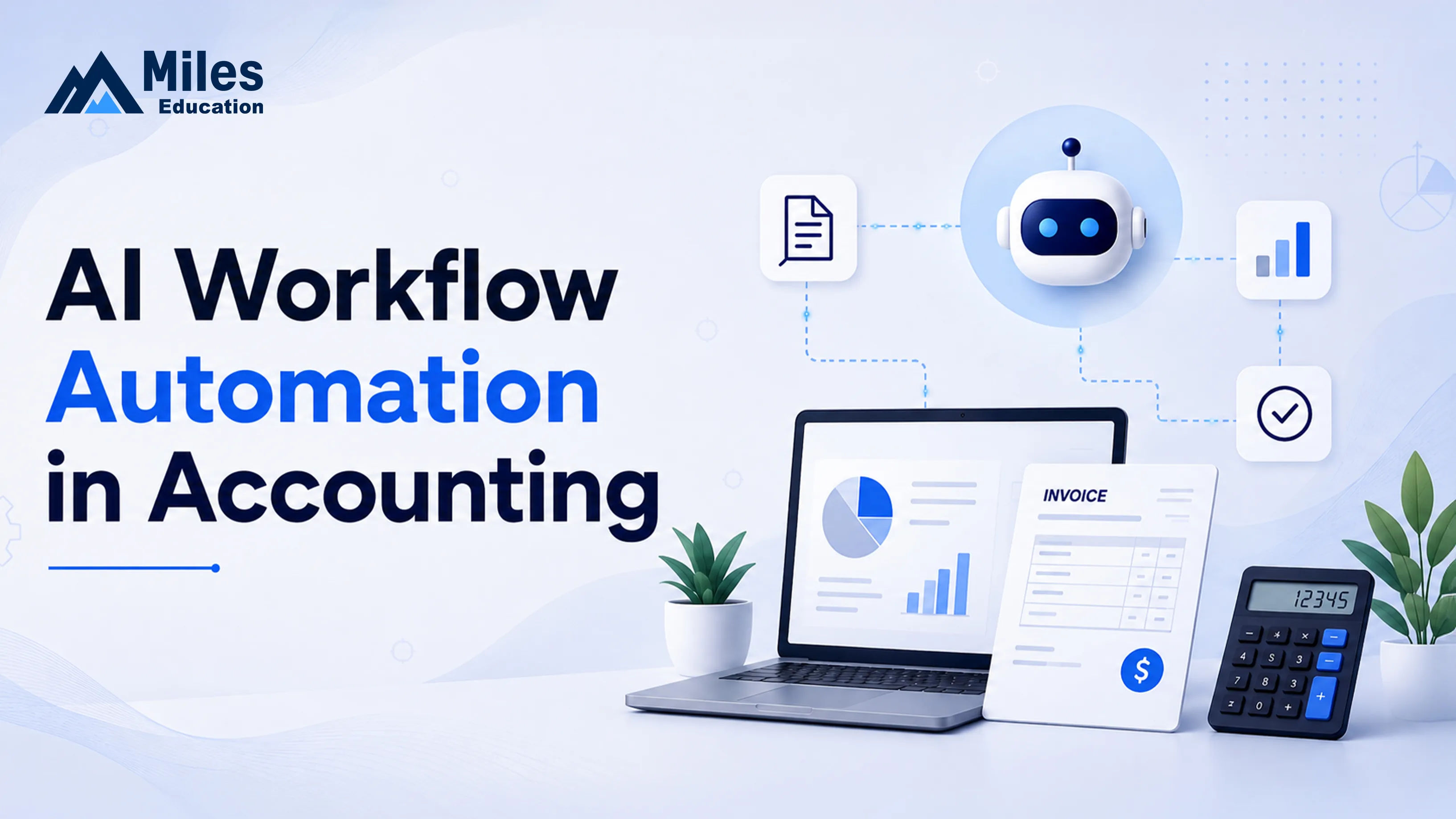
Two years ago, "AI in accounting" mostly meant a chatbot in the corner of your screen. In 2026, it means something structurally different: an AI workflow that picks up a task, runs it end-to-end across your systems, and only comes back to a human when something breaks a rule.
That shift - from AI as a tool you open to AI as a workflow that runs - is the real story of the year. Here's what it actually looks like on the ground.
The 2026 baseline: adoption is high, redesign is not
The headline numbers show a profession that has bought the technology but hasn't finished rewiring around it.
What the data says | Figure |
|---|---|
Finance teams with AI solutions fully deployed and in active use | 63% |
Those reporting clear, measurable ROI | 21% |
Finance chiefs naming AI agents their top digital-transformation priority for 2026 | 54% |
Organisations that have fully integrated AI agents into finance | 14% |
Accountants using AI inside their accounting software and core work tools | ~53% |
Firms that have adopted AI in at least one operational workflow | 41% |
Respondents expecting AI to be the most transformative finance technology in 12–24 months | 88% |
Those who say their organisation is very well prepared | 8% |
The gap between 63% and 21% is the whole opportunity. Deployment is outpacing workflow redesign - most teams have bought AI automation tools and dropped them on top of processes designed for humans and paper.
"Our profession is at an inflection point." - Tom Hood, CPA, CGMA, EVP – Business Engagement and Growth, AICPA & CIMA
What an AI workflow actually is (and isn't)
A useful working definition for 2026:
AI tool - you prompt it, it answers, you copy the answer somewhere. Productivity, not process.
Workflow automation - a rules engine moves work between steps. Fast, but brittle; it snaps when the data shape changes.
AI workflow automation - reasoning sits inside the pipeline. It reads unstructured documents, decides, acts in the source system, logs why, and escalates the exceptions.
The practical test: does a human have to trigger it, and does a human have to finish it? If the answer is no to both for standard cases, you have a workflow, not a tool.
Where AI workflow automation is landing first
Adoption follows a predictable pattern - high-volume, rules-heavy, evidence-rich work goes first.
Function | Typical AI workflow | What the human still does |
|---|---|---|
Accounts payable | Three-way match of invoice, PO and GRN; duplicate and fraud flags | Reviews flagged exceptions, approves outliers |
Accounts receivable | Receivables tracking with escalating reminder cadence | Handles disputes and relationship calls |
Reconciliations | Bank recs run continuously; differences flagged with explanations | Judges materiality, signs off |
Month-end close | Accrual schedules, revenue and deferred revenue computation | Reviews estimates, owns the narrative |
Audit | PBC tracking, confirmations, lease and contract testing at full population | Scopes risk, forms the opinion |
Tax | Document chasing (W-2, 1099, K-1), prior-year-based estimates, credit identification | Positions, planning, client advice |
Expenses | Policy checks on every claim, with reasoning attached to exceptions | Policy design and edge-case calls |
Reported outcomes cluster around the same numbers: roughly 30% faster month-end close (CPA.com), 90%+ auto-reconciliation rates in mature agentic deployments, and AP cost per invoice near $4.98 for automated processors versus $12.44 for bottom-quartile manual teams. HPE's finance team, running an internally built agentic tool developed with Deloitte, has cut its financial reporting cycle by about 40%.
Marie Myers, CFO of Hewlett Packard Enterprise, told CFO Dive her team is set to drive "far more use of agentic AI inside of finance" this year.
The 2026 stack: what teams are actually building on
You do not need a data-science team to make AI automation work. The dominant pattern in mid-market finance is a Microsoft-centred stack, because the data and the controls already live there.
Layer | Tool | Job in the workflow |
|---|---|---|
Assistant | Microsoft 365 Copilot | Drafting, summarising, first-pass outputs in Excel, Word, Outlook |
Analytics | Power BI | Dashboards, KPI tracking, exception detection across full datasets |
Orchestration | Power Automate | Approvals, routing, reminders, evidence filing - with an audit trail |
Agents | Copilot Studio | Accounting assistants grounded in your own SOPs |
ERP-native | NetSuite, SAP, Dynamics AI modules | Coding, matching, close tasks inside the system of record |
How to create AI workflows that survive contact with an audit
A repeatable sequence that works whether you're a 12-person firm or a group finance team:
Pick one bleeding process. Highest volume × most manual × clearest rules. AP matching and bank recs are the usual first wins.
Write the SOP before the prompt. Undocumented processes cannot be automated - AI needs formalised, uniform steps to work from.
Define the exception rule. Decide upfront what the agent must escalate. This is the control, and it's what your auditor will ask about.
Build in a sandbox. No client data, no production licences. Break it privately.
Run parallel for one cycle. Human and agent side by side; measure error rate, not just hours saved.
Instrument it. Every action timestamped with its decision rationale - automated audit trails are a compliance advantage manual workflows can't match.
Redeploy the hours. Firms winning in 2026 free 15–20 hours per accountant per week and push that into advisory, where rates run 40–60% higher.
The real bottleneck isn't the technology
Only 8% of finance organisations describe themselves as very well prepared for AI. The constraint is people who can specify, build and govern these workflows - a different skill from operating them.
Hood again, on the AICPA's own AI skills programme: "The opportunity is not simply to adopt AI faster, but to adopt it better."
AICPA CEO Mark Koziel frames the destination as the accountant staying "human in the lead" - the professional who owns judgement, review and assurance over the machine's output. That's a job description, and it needs training.
This is where credentialed, hands-on programmes matter. Miles Education, one of India's largest US CPA and CMA training providers, has built CAIRA (Certified AI-Ready Accountant) around exactly this gap - a three-level, 90-hour path with NASBA-approved CPE credits that runs from AI readiness on the Microsoft stack, through applied AI across audit, tax and client accounting services, to a firm-wide AI operating model. The distinguishing piece is Miles AI Labs, where teams build real agents - AP three-way match, AR collections, bank reconciliation, PBC trackers, 1099 chasers - in a sandbox with no client data and no firm licences required.
The accountants who will matter in 2027 aren't the ones who used AI. They're the ones who built the workflow, wrote the exception rule, and signed off on the result.
FAQs
1. What is AI workflow automation in accounting?
It's the use of AI agents to run a finance process end-to-end - reading documents, deciding, acting in your ERP or ledger, and escalating only the exceptions - rather than a person prompting an AI tool for one output at a time.
2. How is it different from RPA?
RPA follows fixed rules and fails when a process or data structure changes. AI workflows reason over unstructured inputs and adapt, which is why they hold up on invoices, contracts and client documents that never arrive in the same format twice.
3. Which accounting workflows should be automated first?
Start with high-volume, rules-heavy work with clean evidence: AP three-way match, bank reconciliations, expense policy checks, and document collection for tax and audit.
4. What AI automation tools do accountants actually use?
Most mid-market teams build on Microsoft 365 Copilot, Power BI, Power Automate and Copilot Studio, supplemented by AI features native to their ERP and tax software.
5. Will AI workflows replace accountants?
The consistent view from the AICPA is no - routine execution shifts to machines while accountants move into review, assurance and advisory. The risk isn't replacement; it's being unable to supervise work you never learned to specify.
6. How do I learn to build AI workflows?
Look for hands-on, CPE-bearing programs with a build environment rather than lecture-only courses. Miles Education's CAIRA credential and its AI Labs are one route designed specifically for accounting and finance professionals.