This comprehensive 2026 technology guide explores the massive evolution of artificial intelligence in corporate finance. We break down the core differences between reactive and autonomous systems, review top digital tools, and show you exactly how to future-proof your accounting career against the massive automation wave.
What is Generative AI? It is a type of artificial intelligence designed to produce new content. It creates financial reports, text, or data models reactively based on user prompts.
The global accounting landscape has shifted massively in 2026. Routine bookkeeping is completely dead. Today, top multinational companies are no longer just using artificial intelligence to write emails.
They are actively deploying autonomous systems. These systems can execute entire month-end close procedures independently without human intervention.
If you are a finance professional mapping out your future, you have likely heard this tech jargon thrown around in the corporate boardroom. You are probably wondering how these new systems impact your daily workflow.
In this comprehensive 2026 guide, we will break down the fundamental differences between these two powerful technologies. We will explore practical use cases, review the latest industry tools, and show you exactly how to secure a high-paying executive career.
Understanding What is Gen AI
Before comparing the two concepts, we must define the baseline technology. When candidates ask, what is Gen AI, they are referring to digital systems trained on massive datasets.
These platforms strictly respond to human instructions. They do not think for themselves.
They wait for a prompt, process the request, and instantly produce an output. In the corporate finance world, this technology is primarily used for rapid data summarization and content drafting.
For example, a modern auditor can upload a 100-page lease agreement. The system will instantly read the dense document. It then provides a concise, accurate summary of the key financial liabilities in seconds.
Generative AI Examples and Tools
The market is currently flooded with powerful Gen AI tools. From drafting client emails to building complex Excel formulas, these platforms save professionals hundreds of hours every month.
Here are a few practical Generative AI examples utilized in a modern finance department:
Financial Summarization: Turning dense quarterly earnings transcripts into bulleted executive summaries.
Client Communication: Drafting personalized, professional emails to vendors regarding overdue corporate invoices.
Variance Explanations: Reading budget reports and writing clear explanations for unexpected revenue drops.
Professionals frequently use Generative ai tools to streamline these routine communication tasks. Any AI generated report still requires a human accountant to review the final output before sending it to the Chief Financial Officer (CFO).
What is Agentic AI? The Autonomous Executor
While the previous technology focuses purely on creating content, Agentic AI focuses strictly on execution. It represents the next major evolution in corporate technology.
Agentic AI refers to autonomous systems that can perceive their environment. They independently plan multi-step workflows and take proactive action to achieve a specific business goal.
Unlike older systems that wait for a prompt, agentic systems are highly proactive. You give the system a high-level goal. The system breaks that goal down into actionable steps. It securely logs into your Enterprise Resource Planning (ERP) software and executes the task.
For instance, an agentic system can automatically monitor a company's daily bank feed. If it spots a missing vendor payment, it acts immediately. It automatically investigates the invoice, flags the discrepancy, and routes it to a human manager for final approval.
This massive shift moves artificial intelligence from a passive assistant into a highly active digital coworker.
Core Differences Between the Technologies
To truly understand the Generative AI meaning, you must see how it contrasts directly with autonomous agents.
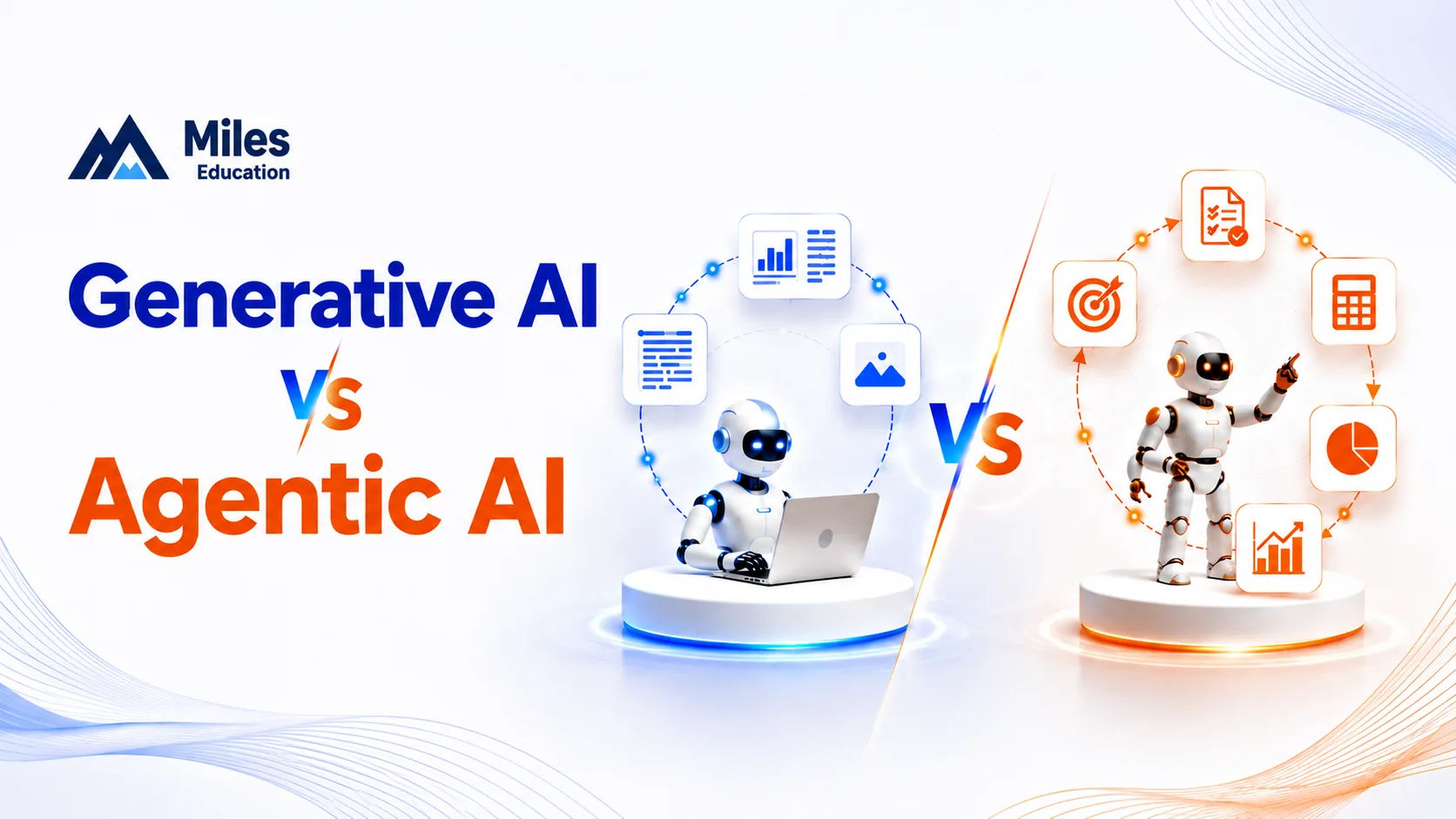
Here is a clear breakdown of the exact differences:
Feature | Generative AI | Agentic AI |
|---|---|---|
Primary Function | Creates new content, text, or data summaries. | Executes multi-step workflows and corporate actions. |
Behavioral Style | Highly reactive (waits for a specific prompt). | Highly proactive (works toward a defined goal). |
System Autonomy | Requires constant human direction and input. | Operates independently across integrated software. |
Typical Output | An AI generated draft or data analysis. | A completed business task or system update. |
Accounting Use Case | Drafting a budget variance explanation. | Autonomously reconciling a massive bank ledger. |
As the table shows, the core difference lies entirely in autonomy. One system writes the plan, while the other actually executes the work.
The Shift in Generative AI Models
In 2026, the underlying Generative AI models are getting much smaller, faster, and highly integrated. We are moving far away from isolated, standalone online AI chatbots.
Today, these models are built directly into standard corporate software. They act as the "brain" for the newer agentic systems. For example, an agentic workflow might use a language model to read a vendor invoice, but it uses its own agency to actually pay that invoice.
Building the Future: Google Gen AI Exchange Program
Major technology companies are actively driving this massive digital shift. They desperately want developers and finance professionals to build integrated, autonomous workflows.
A prime example is the Google Gen AI exchange program. This global initiative brings together brilliant developers, IT practitioners, and startup founders. Their goal is to solve real-world corporate problems using advanced cloud technology.
Through the Gen AI exchange program, participants leverage advanced Google Gen AI capabilities to build custom financial tools. They tackle massive business challenges faced by modern CEOs across the globe.
Programs like this prove a massive shift in corporate intent. The industry is no longer just trying to generate AI text. They want to AI generate completely automated, end-to-end business solutions.
By empowering professionals to build these systems, the accounting industry is becoming exponentially faster and more accurate. Candidates who understand these advanced systems will secure the highest-paying roles in the market.
Elevate Your Finance Career with Miles Education
Bridging the massive gap between traditional accounting and high-level tech integration takes elite mentorship. You really cannot navigate this massive corporate shift completely alone.
At Miles Education, we build world-class, future-ready financial leaders. We do not just teach you how to pass global exams like the US CPA or CMA. We ensure your specific skill set easily survives the massive automation wave hitting the industry.
Led by industry expert Varun Jain, our highly interactive masterclasses completely ditch boring rote memorization. We focus heavily on deep, punchy conceptual clarity.
Through our exclusive Certified AI-Ready Accountant (CAIRA) program, you will learn exactly how to integrate these powerful technologies directly into your daily finance workflows.
You will master advanced prompt engineering, automated data analytics, and digital AI agents. Instead of fearing automation, you will learn exactly how to command it.
Through the premium Miles Talent Hub, we actively connect our tech-enabled graduates directly with top Big 4 accounting firms. We also place candidates in over 220+ massive multinational corporations (MNCs). We do not just teach you the syllabus; we launch your premium executive career.
Conclusion
Understanding the exact difference between Agentic systems and Generative AI is the absolute first step toward a highly lucrative career in corporate finance.
While generating content is incredibly useful for daily communication, autonomous execution is the true future of the industry. Stop settling for low-paying, repetitive data entry roles that software will inevitably replace anyway.
Take total control of your professional growth today. Partner with elite mentors at Miles Education, master modern corporate technology, build your AI execution skills, and confidently claim your massive executive salary.
Frequently Asked Questions (FAQs)
1. What is Generative AI in simple terms?
Generative AI is a type of artificial intelligence that creates new content, such as text, code, or images, strictly based on user prompts. It acts as a reactive tool, requiring human instructions to produce financial summaries or draft emails.
2. What is Gen AI used for in accounting?
Accounting professionals use these systems to automate routine communication tasks. Common use cases include summarizing lengthy financial documents, drafting client emails, and explaining complex budget variances quickly without spending hours typing.
3. How does Agentic AI differ from standard models?
While standard models reactively create content, Agentic AI proactively executes tasks. An agentic system can independently plan a multi-step workflow, log into corporate accounting software, and reconcile bank statements with minimal human supervision.
4. Will AI generated systems replace accountants?
No, these systems will not replace strategic accountants. While they easily eliminate manual data entry and routine bookkeeping, companies desperately need certified professionals to oversee these systems, interpret the data, and drive high-level executive business decisions.