The AI Factor: Why "AI-Ready" Is the New Non-Negotiable
If there's one theme that should shape how you choose your accounting course in 2026, it's this: technical accounting knowledge gets you in the door, but AI fluency decides how far you go.
"The best way to predict the future is to invent it." - Alan Kay
A few numbers that explain why employers are obsessed with AI-ready talent:
AI-skilled professionals in business and finance command roughly a 56% wage premium over peers without those skills (Auxis, 2026). Read that again. More than half.
GenAI usage inside tax, audit, and accounting firms jumped to 21% in 2025 from just 8% in 2024, according to Thomson Reuters - and the same research estimates AI can save an individual CPA around 240 hours a year.
Gartner found 58% of finance functions were already using AI in 2024, up 21 percentage points in a single year.
Even the Big 4 are reshaping entry-level hiring around automation, trimming graduate intake for routine roles - a clear signal that the "junior who only does data entry" job is fading, while the "junior who can drive AI tools" job is rising.
The takeaway is simple but career-defining: the best accounting courses after graduation are no longer the ones that only teach accounting. They're the ones that bolt an AI capability layer onto your credential. This is exactly the gap that newer programs like CAIRA were built to fill - more on that shortly.
The Best Accounting Courses After Graduation (Your 2026 Shortlist)
Ready for the accounting courses list you actually came for? Below are the highest-ROI options for graduates in 2026 - what each one is, who it suits, how long it takes, and the kind of pay it unlocks in India. Think of this less as a ranking and more as a menu: the "best" accountant course is the one that matches your destination.
1. US CPA - The Global Gold Standard
The US Certified Public Accountant (CPA) is the U.S. equivalent of India's CA and one of the most respected accounting and finance qualifications on the planet. If your dream is the Big 4, global MNCs, or audit and assurance work built on US GAAP and IFRS, this is your flagship US accounting course.
Structure: 4 exam sections, completable in roughly 12 months
Best for: Graduates eyeing Big 4 firms, Global Capability Centers (GCCs), and international mobility
2026 pay in India: A fresher US CPA at a GCC often starts around ₹7–10 LPA, compared with the ₹3–4 LPA a standalone B.Com graduate might see - with experienced CPAs climbing well past ₹30 LPA
2. US CMA - The Strategic Finance Powerhouse
If CPA is about assurance, the US Certified Management Accountant (CMA) is about strategy. This is the credential for graduates who want to forecast revenues, manage costs, and sit in the room where business decisions are made. Miles is an IMA Platinum Partner, and the CMA is famously efficient.
Structure: Just 2 exam parts, completable in around 8 months
Best for: Future FP&A analysts, finance managers, cost controllers, and CFOs-in-the-making
2026 pay in India: Freshers typically land ₹6–10 LPA (often higher at MNC GCCs), and the IMA's global salary surveys consistently show CMAs out-earning their non-certified peers by a wide margin
3. US EA - The Taxation Specialist's Route
Love the puzzle of tax? The US Enrolled Agent (EA) is the most focused accounting and taxation course on this list. An EA is federally authorized to represent taxpayers before the IRS - a powerful niche as cross-border tax and compliance grow ever more complex in 2026.
Best for: Graduates who want a tax-first career, especially supporting US tax workflows from India
Why it's hot: As tax rules multiply across jurisdictions, firms are hungry for dedicated tax talent who can pair domain depth with AI-assisted research
4. CAIRA - The Missing AI Layer Every Accountant Now Needs
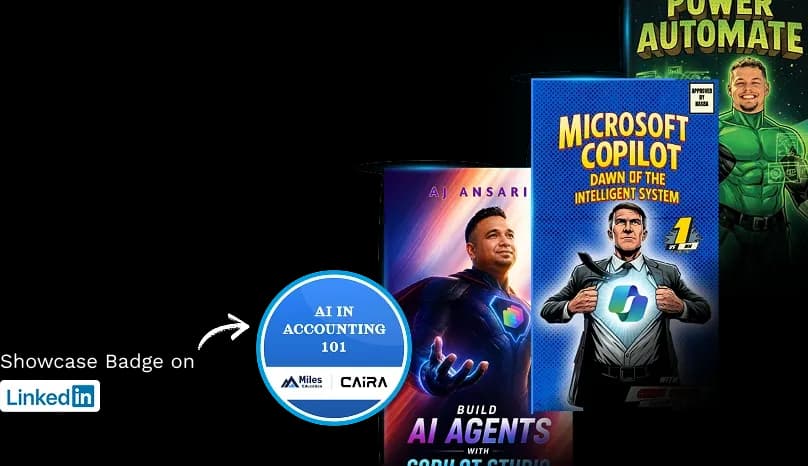
Here's where 2026 genuinely breaks from the past. CAIRA (Certified AI-Ready Accountant) isn't a replacement for CPA or CMA - it's the AI capability layer that sits on top of your accounting credential and makes you genuinely future-proof. Built by Miles with global accounting innovators, it's a credential designed for the exact shift the data above describes.
Format: A 9-month guided pathway, roughly 3 hours a week - 90 hours across 3 levels, with NASBA-approved CPE
What you learn: The Microsoft AI stack for accountants - Copilot, Power BI, Power Automate, and Copilot Studio - progressing from AI foundations and structured prompting (Level 1), to applied AI across audit, tax, and CFO/FP&A functions (Level 2), to AI leadership, agentic AI, and governance (Level 3)
Why it pays: Miles' own analysis suggests an AI-ready accountant (CPA + CAIRA) can command a 15–20% premium, because they effectively do the work of several people using AI tools
The price detail graduates love: CAIRA Level 1 live webinars are free for Miles CPA/CMA candidates, and the full three-level program carries a special India price well below the global $999 tag
CAIRA is why employers from Deloitte, EY, KPMG, PwC, RSM, BDO, Grant Thornton, Accenture, and JP Morgan increasingly value candidates who've added an AI credential to their core qualification.
5. US Pathway for Accountants - Your Route to Working in America
Not strictly a single course, but worth knowing if your ambition is to live and work in the US. The Miles US Pathway combines STEM-designated accounting programs with an F-1 visa → OPT → career route, purpose-built for placements at mid-tier and Top-100 US CPA firms.
How to Choose the Right Accounting Course After Graduation
An accounting courses list is useless without a way to navigate it. Use this quick decision guide - find the row that sounds like you:
"I want global recognition and a Big 4 audit career." → Start with US CPA, then layer on CAIRA.
"I want to be a strategic, decision-driving finance leader." → US CMA is your fast, focused route - add CAIRA to stand out.
"I'm fascinated by tax and compliance." → The US EA accounting and taxation course is built for you.
"I want to physically work in the United States." → Follow the US Pathway for Accountants.
"I already have (or am doing) a credential - I just need to be AI-ready." → CAIRA, full stop.
Notice a pattern? In nearly every lane, the smartest 2026 move is credential + CAIRA. The accounting qualification proves you understand the numbers; the AI layer proves you can move at the speed employers now demand.
Online Accounting Courses: Learning That Fits Your Life
Here's the good news for working graduates and final-year students juggling a hundred things at once: you no longer have to choose between a job and a qualification. The best online accounting courses in 2026 are genuinely built around your schedule.
Miles delivers its programs through live online classes and the Miles One App - the platform built for AI-ready accountants - so you can prep for your CPA or CMA, attend expert masterclasses, and earn CPE-eligible AI credits from anywhere. Many students even clear exams during graduation to walk straight into a head-start career. When people search for "accounting courses online" today, what they really want is flexibility without a drop in quality - and that's exactly the bar a modern accountancy course should clear.
A quick, honest tip on choosing any online accounting course: look for live instruction, an active question bank, mock exams, and real placement support - not just a library of recorded videos you'll never finish. (We've all bought that gym membership. Don't make your career the same mistake.)
Why Learn With Miles Education
Choosing where to study matters as much as what to study - so a little transparency on credentials (because trust should be earned, not assumed):
IMA Platinum Partner for the US CMA, and a leading institute for the US CPA in India
CAIRA built with global accounting leaders and innovators, with NASBA-approved CPE credits
Miles Talent Hub connects certified alumni directly with Big 4 firms and Fortune 500 GCCs
A complete ecosystem - from CPA, CMA, and EA, to the AI-ready CAIRA credential and a structured US Pathway - so your next step is never a guess
Miles alumni work across Deloitte, EY, KPMG, PwC, RSM, Grant Thornton, Accenture, JP Morgan, and dozens of GCCs shaping the future of finance - a reasonable signal that the training translates into real careers.
Your 2026 Action Plan
Let's turn all of this into momentum:
Pick your core credential based on your destination - CPA for global assurance, CMA for strategic finance, EA for tax.
Add the AI layer early. Don't wait until employers demand it - by then you're behind. CAIRA's free Level 1 webinars for Miles CPA/CMA candidates make starting effortless.
Choose an online format that fits your life so the qualification works around your job or final year, not against it.
Lean on placement support. A great course doesn't just teach - it opens doors.
The accounting profession of 2026 rewards a very specific kind of professional: one who understands the numbers and knows how to make AI do the heavy lifting. The graduate who recorded history is being automated. The graduate who shapes the future - armed with a respected credential and genuine AI fluency - has never been more in demand.
So frame that degree, take a breath, and pick your path. The best accounting course after graduation is the one that turns "so… what now?" into "watch me."
FAQs
1. What are the best accounting courses after graduation in 2026?
For most graduates, the strongest options are the US CPA (global audit and assurance), the US CMA (strategic finance and FP&A), and the US EA (taxation). In 2026, the highest-impact move is pairing any of these with CAIRA (Certified AI-Ready Accountant) to add the AI skills employers now expect.
2. Which accounting course is best if I want to work abroad?
The US CPA offers the widest global recognition, while the Miles US Pathway - with STEM-designated programs and an F-1 → OPT route - is purpose-built for graduates who want to physically work in the United States.
3. Is an accounting career safe given AI and automation?
Yes, with the right skills. Research from Stanford–MIT, Gartner, and the World Economic Forum shows AI is augmenting accountants rather than replacing them, even as the profession faces a major talent shortage. The risk isn't AI - it's being an accountant who can't use AI. That's precisely why an AI-ready credential matters.
4. What is CAIRA, and do I need it?
CAIRA (Certified AI-Ready Accountant) is a 9-month, 3-level, NASBA-approved program that teaches accountants to use AI tools like Microsoft Copilot, Power BI, Power Automate, and Copilot Studio across audit, tax, and finance. It doesn't replace a CPA or CMA - it's the AI capability layer on top. With AI-skilled finance professionals commanding sizeable wage premiums, it's one of the smartest add-ons for a 2026 graduate.
5. Are there good online accounting courses for working graduates?
Absolutely. Miles delivers CPA, CMA, EA, and CAIRA through live online classes and the Miles One App, so you can study around a job or your final year. When comparing online accounting courses, prioritize live instruction, strong question banks, mock exams, and placement support.
6. What salary can I expect after an accounting course in India?
In 2026, a fresher US CPA or CMA at a GCC or Big 4 firm commonly starts around ₹6–10 LPA, versus roughly ₹3–4 LPA for a standalone commerce graduate - and adding AI skills (via CAIRA) can push that further, with experienced professionals reaching ₹30 LPA and beyond.
7. How long do these accounting courses take?
The US CMA is the fastest at around 8 months (2 exam parts), the US CPA typically takes about 12 months (4 sections), and CAIRA runs as a 9-month guided pathway at roughly 3 hours a week - easy to pursue alongside your core credential.