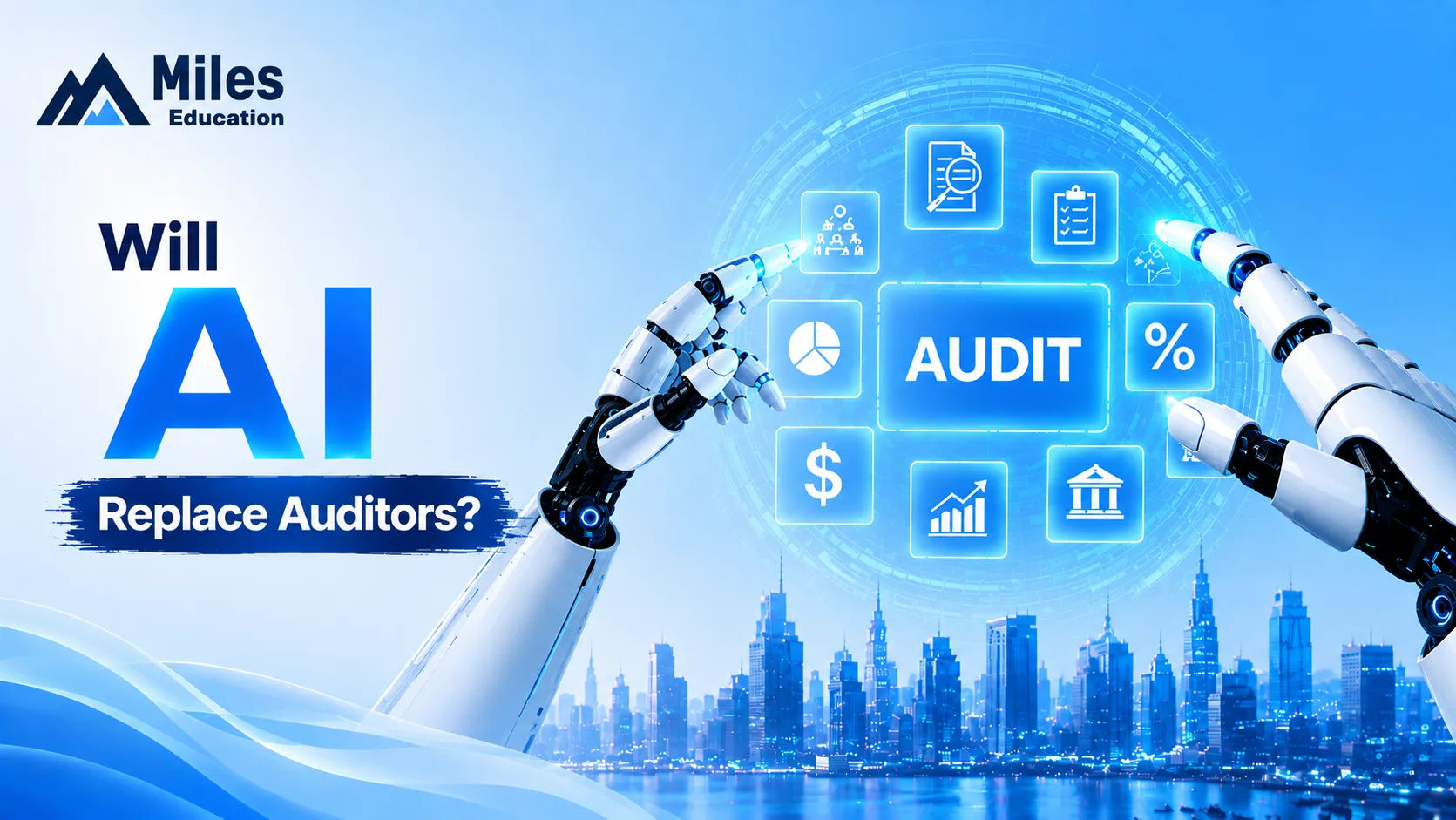
This data-driven 2026 analysis examines whether artificial intelligence will replace modern auditors. We break down the real employment data, separate automation myths from reality, explore how auditing roles are shifting toward strategic advisory, and show how accounting professionals can thrive alongside emerging AI tools.
Will AI replace auditors? No, artificial intelligence will not replace auditors. Instead, AI automates repetitive data sampling and manual reconciliations, transforming auditors from manual number checkers into strategic risk advisors who interpret complex financial data and exercise professional skepticism.
The global accounting landscape has experienced massive technological shifts over the past few years. Sensational headlines frequently declare that machine learning will eliminate corporate accounting departments entirely.
If you are a commerce student or an active finance professional, you might feel anxious about these claims. You are probably wondering: will AI replace accountants?
You might also ask if spending hundreds of hours earning elite qualifications like the US CPA or CMA is still worth it.
The short answer is a resounding yes. The real data tells a completely different story from the social media hype.
In this comprehensive 2026 guide, we will examine what the empirical data reveals about automation in audit. We will explore how your daily responsibilities are evolving, and show you how to position yourself at the top of the profession.
What the Data Shows: Will AI Replace Accountants and Auditors?
When evaluating career security, it is critical to look at concrete hiring figures rather than alarmist speculation.
Global employment surveys and industry reports from major regulatory bodies show that demand for certified public accountants and auditors remains at record highs. While entry-level data entry roles have declined, the demand for licensed professionals with analytical judgment has increased significantly.
In India alone, the expansion of over 1,700 Global Capability Centers (GCCs) for Fortune 500 corporations has created an unprecedented shortage of qualified accounting talent. Big 4 accounting networks (Deloitte, PwC, EY, KPMG) continue to recruit thousands of auditors every quarter.
Here is a look at how artificial intelligence is changing the audit workflow:
Traditional Audit Task | How AI Handles It | The Human Auditor's Real Role |
|---|---|---|
Transaction Sampling | Tests 100% of journal entries in seconds. | Evaluates anomalous patterns and investigates high-risk flags. |
Voucher Matching | Scans invoices, purchase orders, and receipts automatically. | Assesses management intent, fraud risk, and contractual nuance. |
Lease & Contract Review | Extracts key financial terms and liability clauses instantly. | Determines the appropriate accounting treatment under US GAAP / IFRS. |
Inventory Verification | Uses drone feeds and computer vision to track physical counts. | Tests valuation methodologies and writes formal audit opinions. |
As the data shows, automation eliminates routine clerical work. However, it cannot replace the legal responsibility, ethical judgment, and client consultation that define a licensed auditor.
How Will AI Replace Accountants' Repetitive Tasks?
To understand why the profession is safe, we must look at how will AI replace accountants in daily mechanical execution.
For decades, traditional auditing relied heavily on manual sampling. An audit team would select a random 5% sample of sales invoices and spend weeks manually verifying numbers against shipping documents.
This process was slow, monotonous, and prone to human oversight.
Today, advanced machine learning algorithms analyze entire populations of millions of transactions in real time. The software instantly flags anomalies, duplicate payments, and suspicious after-hours ledger entries.
Using AI to replace accountants in these repetitive data-matching tasks is a massive benefit for the industry. It removes the low-value administrative burden from junior accountants.
Instead of spending late nights copying numbers into spreadsheets, young auditors can now spend their time analyzing corporate risk, testing internal controls, and communicating findings to executive leadership.
Can AI Replace Auditors in Enterprise Risk and Internal Governance?
A critical question many practitioners ask is: can AI replace auditors when evaluating internal controls and corporate governance?
The answer comes down to professional skepticism. Machine learning models identify correlations based on historical data. They do not understand business context, human psychology, or executive pressure.
Consider the role of internal auditors. When evaluating will AI replace internal auditors, one must look at what internal audit actually does:
Evaluating Corporate Culture: Assessing whether leadership creates an ethical tone at the top cannot be measured purely by an algorithm.
Detecting Executive Fraud: Management override of controls often involves complex, collusive schemes designed specifically to deceive automated monitoring systems.
Evaluating Qualitative Risk: Assessing geopolitical vulnerabilities, regulatory changes, and cybersecurity readiness requires holistic human insight.
An algorithm cannot sit in a boardroom, interview a Chief Risk Officer, evaluate executive body language, or deliver a difficult audit finding to an audit committee. For these reasons, could AI replace auditors in subjective evaluation? The data proves it cannot.
The Future: Will AI Replace Accountants in the Future?
As we look toward the next decade of finance, a well-known industry principle rings true: AI will not replace auditors, but auditors who use AI will replace those who do not.
When considering will AI replace accountants in the future, the conversation must shift from job elimination to skill transformation.
The modern auditor is no longer a historical record-keeper. The modern auditor is a data-fluent financial strategist.
Leading accounting firms are shifting their entire service delivery model toward continuous, predictive auditing. Rather than conducting an audit once a year after books are closed, firms monitor client transactions continuously using automated data pipelines.
Auditors who master prompt engineering, data visualization tools, and automated audit software command massive salary premiums. In India, tech-enabled CPAs and CMAs working within multinational GCCs routinely earn starting packages between ₹8 Lakhs and ₹12 Lakhs, scaling rapidly past ₹25 Lakhs as they step into management.
Become an AI-Ready Finance Leader with Miles Education
Navigating the intersection of global accounting standards and emerging enterprise technology requires elite mentorship. You should not prepare for the future of finance with outdated learning models.
At Miles Education, we build world-class, future-ready financial leaders. Over 80% of all US CPAs working across India today are proud Miles alumni.
Led by industry expert Varun Jain, our masterclasses eliminate boring rote memorization. We focus on deep conceptual clarity, helping candidates master US GAAP, auditing standards, and financial strategy.
The CAIRA Advantage: Lead the AI Era
We ensure your skill set survives and leads the technological revolution.
Through our exclusive Certified AI-Ready Accountant (CAIRA) program, we train finance professionals to integrate powerful artificial intelligence tools directly into their daily audit and tax workflows.
You will master Microsoft Copilot, advanced data analytics with Power BI, and digital AI workflows designed specifically for corporate finance. Instead of worrying about automation, you will learn how to command it.
Furthermore, through the premium Miles Talent Hub, we actively connect our tech-enabled graduates directly with top Big 4 firms and over 220+ multinational corporations. We do not just help you pass your exams; we launch your executive career.
Conclusion
The debate around whether will AI replace auditors is settled by the data: automation is an accelerator, not a replacement. While algorithms take over mundane data entry, the demand for strategic, ethically grounded, and certified auditors has never been stronger.
Stop worrying about software replacing your career. Take control of your professional trajectory in 2026. Upgrade your analytical capabilities, earn your global US CPA or CMA certification, master cutting-edge AI tools with Miles Education, and confidently step into the executive boardroom.
Frequently Asked Questions (FAQs)
1. Will AI replace auditors completely in the coming years?
No, artificial intelligence will not replace auditors completely. While software automates data extraction and routine reconciliation, auditors are legally and operationally required to apply professional skepticism, assess qualitative risk, and provide certified opinions on financial statements.
2. Can AI replace auditors at Big 4 accounting firms?
No. Big 4 firms use machine learning to test 100% of transaction populations, but they are hiring record numbers of certified accountants to interpret those outputs. The technology enhances audit quality rather than reducing the need for human judgment.
3. How will AI replace accountants performing daily compliance?
AI automates repetitive compliance tasks like optical character recognition (OCR) for invoices, automated three-way matching, and standard tax calculations. This shifts accountants away from manual data entry and allows them to focus on tax planning and strategic advisory.
4. Will AI replace internal auditors managing enterprise risk?
No, internal auditing requires evaluating corporate culture, assessing fraud incentives, and testing qualitative governance controls. These responsibilities depend heavily on human emotional intelligence, negotiation, and subjective business judgment that algorithms cannot replicate.
5. What skills do auditors need to thrive alongside AI?
To thrive, modern auditors must build strong conceptual accounting foundations (such as US GAAP) while mastering data analytics tools like Power BI, advanced prompt engineering, and automated enterprise audit platforms.