If you're a finance or accounting professional in 2026, you've probably typed "CMA or CFA which is better" into Google at least once - and come away more confused than when you started. Both are globally respected US credentials. Both promise better salaries. Both look impressive on LinkedIn.
But here's what most comparison articles miss: the CMA vs CFA decision looks completely different in the AI era than it did five years ago. Generative AI, agentic workflows, and automation tools like Microsoft Copilot and Power BI are reshaping what employers actually pay finance professionals to do. Routine analysis is being automated; judgment, strategy, and AI-augmented decision-making are what command a premium.
So the real question isn't just "CFA or CMA" - it's which credential positions you better for a career where AI does the grunt work and humans do the thinking?
Let's break it down properly.
First, the Basics: What Are the CMA and CFA?
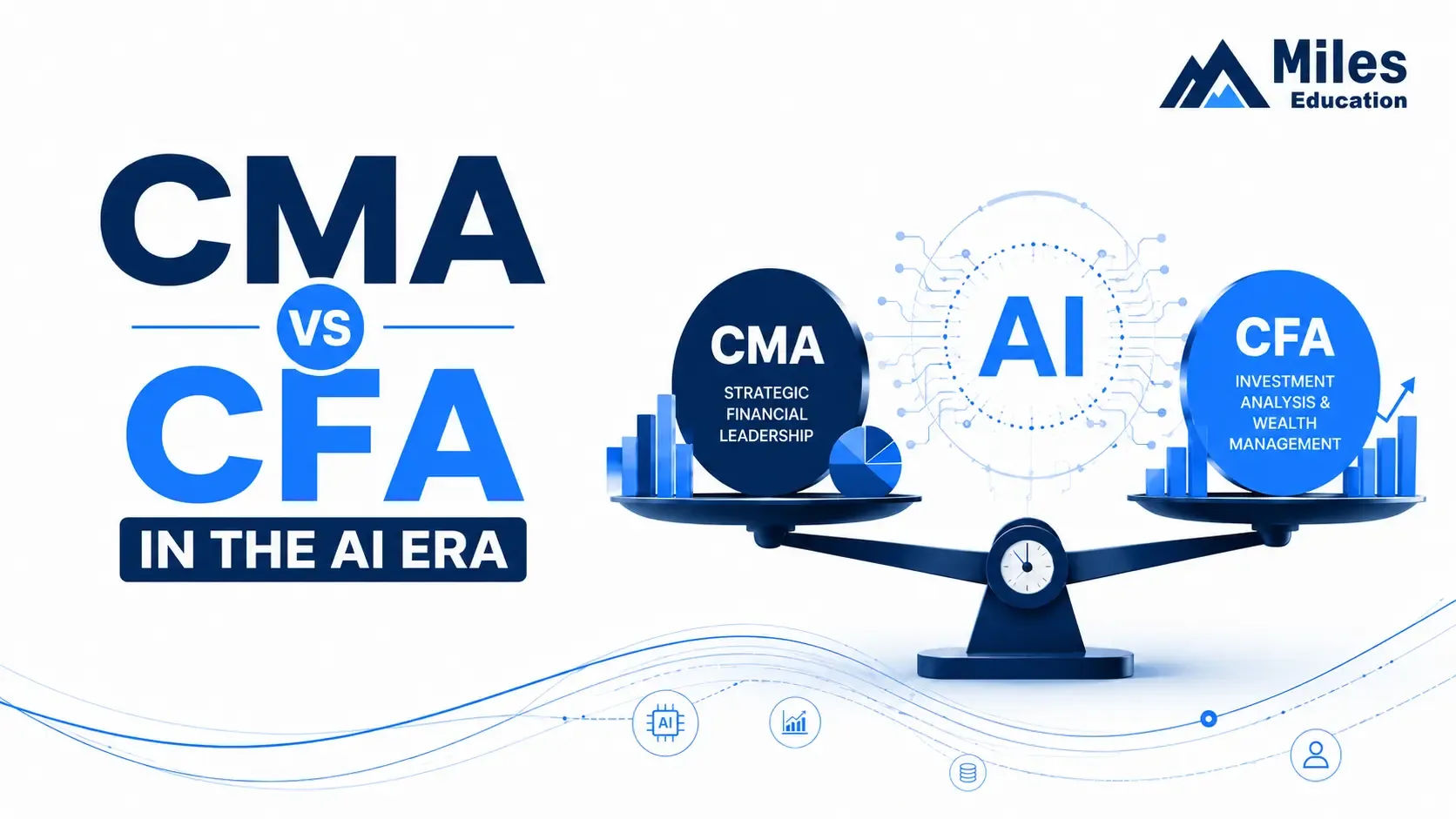
CMA (Certified Management Accountant) is awarded by the Institute of Management Accountants (IMA), USA. It's the gold standard for management accounting and corporate finance - the credential for professionals who want to sit inside a business and drive its financial strategy: FP&A, budgeting, cost management, performance analysis, controllership, and ultimately CFO-track roles.
CFA (Chartered Financial Analyst) is awarded by the CFA Institute, USA. It's the gold standard for investment management - built for careers in equity research, portfolio management, asset management, investment banking, private equity, and wealth management.
The simplest way to remember the difference:
CMA = managing money inside a company.
CFA = managing money in the markets.
CMA vs CFA: Side-by-Side Comparison (2026)
Factor | US CMA | CFA |
|---|---|---|
Awarding body | IMA (Institute of Management Accountants), USA | CFA Institute, USA |
Focus | Management accounting, FP&A, strategy, corporate finance | Investment analysis, portfolio management, markets |
Exam structure | 2 parts | 3 levels |
Typical duration | 12–18 months (many finish in under a year) | 2.5–4 years (each level requires ~300 hours of study) |
Pass rates | Roughly 45–50% per part | Often under 40% at Level I; completing all three levels is among the toughest journeys in finance |
Approximate total cost | Significantly lower overall; exam and membership fees typically run in the low thousands of dollars (USD) | Higher; enrollment plus three levels of exam fees, before coaching and materials |
Eligibility | Bachelor's degree (any stream; final-year students can appear) + 2 years relevant experience for certification | Bachelor's degree or final year of it; work experience needed for the charter |
Best-fit roles | Financial analyst, FP&A manager, cost controller, finance manager, CFO track | Equity research analyst, portfolio manager, investment banker, fund manager |
Typical employers | MNCs, Big 4, corporates, shared services/GCCs, manufacturing, tech | Asset managers, investment banks, hedge funds, PE/VC firms, research houses |
A few points worth underlining:
Speed matters. The CMA's two-part structure means you can be certified in about a year. The CFA is a multi-year commitment with an overall completion rate across all three levels that is famously low. If time-to-credential and time-to-ROI matter to you, the CMA has a clear edge.
Salary outcomes are strong on both sides - but differently shaped. According to IMA's Global Salary Survey, CMAs in the US report median total compensation of around $124,000, meaningfully higher than non-CMAs. CFA charterholders in front-office investment roles can earn more at the top end, but those roles are fewer, intensely competitive, and concentrated in financial hubs. CMA salaries tend to be more consistent and broadly available because every company - not just investment firms - needs management accountants.
In India and the Middle East, the CMA has particularly strong traction thanks to the boom in Global Capability Centers (GCCs), Big 4 advisory practices, and US-facing finance operations. CFA demand is real but concentrated in investment management pockets (Mumbai, GIFT City, Dubai DIFC).
Where Does the CPA Fit In? (CPA vs CFA and CPA vs CMA)
You can't discuss CMA or CFA without the third heavyweight: the US CPA (Certified Public Accountant).
CPA vs CFA: The CPA is rooted in public accounting - audit, assurance, taxation, and financial reporting - and is a license, not just a certification. The CFA is an investment credential. If you want to sign audit reports, represent clients before the IRS, or build a career in the Big 4's audit and tax practices, it's CPA. If you want to pick stocks and manage portfolios, it's CFA. They barely compete with each other.
CPA vs CMA: This is the closer contest, because both live in the accounting world. The CPA goes deep on external reporting, audit, and compliance; the CMA goes deep on internal decision-making, planning, and strategy. Many ambitious professionals eventually hold both - the CPA + CMA combination is a powerful signal for controller and CFO roles.
So the honest framing of CPA vs CMA vs CFA:
Audit, tax, reporting, public accounting → CPA
Corporate finance, FP&A, business strategy, CFO track → CMA
Investments, markets, portfolio management → CFA
The AI-Era Twist: How Automation Changes the CMA vs CFA Math
Here's where 2026 differs from every "CFA and CMA" comparison written before ChatGPT existed.
What AI is automating
Across both accounting and investment functions, AI is rapidly absorbing the routine layer:
In corporate finance: reconciliations, variance reports, first-draft board decks, transaction matching, and month-end close tasks are increasingly handled by AI copilots and workflow automation. Month-end is becoming "always-on," with exceptions flagged daily instead of discovered late.
In investments: screening, data aggregation, earnings-call summarization, and even first-draft research notes are now AI-assisted. Junior analyst work that once justified armies of associates is shrinking.
What AI cannot automate
Judgment. Context. Accountability. Stakeholder communication. Ethical reasoning. The ability to look at an AI-generated output and know whether it's right, and what to do about it.
This is precisely where both credentials are repositioning:
The CMA has leaned into the shift explicitly. Part 1 of the CMA exam is literally titled Financial Planning, Performance, and Analytics - with dedicated coverage of technology, data analytics, automation, and information systems. From 2026, the IMA is even replacing traditional essays with case-based questions (CBQs) built around realistic business scenarios, testing applied judgment rather than rote writing. The CMA is arguably the most "AI-era-native" of the major accounting credentials.
The CFA Institute has responded too, adding practical skills modules covering areas like Python, data science, and financial modeling to the charter pathway - an acknowledgment that tomorrow's analyst is a human-plus-machine hybrid.
The verdict through an AI lens
If AI compresses the routine layer of finance work, the professionals who thrive are those who pair a strong domain credential with demonstrable AI capability.
The CMA + AI skills combination is exceptionally well-matched to where corporate hiring is going: companies are actively seeking finance professionals who can run Copilot-assisted closes, build Power BI dashboards, automate workflows, and supervise AI agents - all anchored in management accounting judgment.
The CFA + AI skills combination matters most if you're genuinely committed to an investment-management career and prepared for a longer, harder, more competitive road.
CMA or CFA: Which Is Better for You?
There's no universal answer to "cfa or cma which is better" - only a right answer for your goals. Use this quick self-check:
Choose the CMA if you:
Want to work inside companies - FP&A, business finance, controllership, strategy
Want a globally recognized credential in roughly 12 months, not 3–4 years
Prefer a lower-cost, higher-certainty path with strong pass rates
Are targeting MNCs, Big 4 advisory, GCCs, or a long-term CFO trajectory
Want a credential whose syllabus already embraces analytics and technology
Choose the CFA if you:
Are certain you want capital markets: equity research, portfolio management, asset management, IB
Are prepared for a multi-year commitment and ~900+ hours of study
Are targeting investment firms in financial hubs
Find valuation, markets, and securities analysis genuinely exciting (not just lucrative-sounding)
And remember the CPA if your heart is in audit, tax, and public accounting - for many, the smartest sequencing question isn't "CMA CFA?" but "CPA or CMA first, and can I stack them?"
One more practical note: the credentials aren't mutually exclusive forever. Plenty of professionals earn the CMA early (fast, affordable, corporate-relevant), then add the CFA or CPA later once their career direction is crystal clear.
The Missing Layer: Whichever You Choose, Add AI
Here's the uncomfortable truth for 2026: a certification alone - CMA, CFA, or CPA - is no longer the finish line. Employers from the Big 4 to global banks now expect finance hires to arrive AI-ready: comfortable with generative AI, workflow automation, business intelligence tools, and increasingly, agentic AI.
That's why forward-looking candidates are stacking their core credential with a structured AI capability layer rather than picking up scattered YouTube tutorials.
This is also where Miles Education has built one of the most relevant ecosystems for this decade. Best known as a leading institute for US CPA and US CMA training (with alumni across the Big 4 and major MNCs), Miles has extended its focus to the AI side of the equation with CAIRA - the Certified AI-Ready Accountant credential.
CAIRA is a 90-hour, three-level, NASBA-approved CPE program that takes finance and accounting professionals from AI foundations (structured prompting, Copilot, Power BI, Power Automate) through applied AI across audit, tax, and CFO functions, all the way to AI leadership - building agents, automation roadmaps, and governance frameworks. It's taught by global accounting innovators and is designed to complement - not replace - credentials like the CMA, CPA, or CFA by adding the AI capability layer employers are now screening for. Miles even offers CAIRA Level 1 free for its CPA and CMA candidates, effectively letting you build your core credential and your AI edge in parallel.
Final Word
The CMA vs CFA debate was never really about which exam is "harder" or which acronym sounds more prestigious. It's about which career you actually want:
CMA → strategic finance leadership inside businesses, achieved faster and more affordably, with a syllabus already built for the analytics age.
CFA → elite investment management, earned through a longer, tougher, more specialized climb.
CPA → the audit, tax, and public accounting license that anchors the profession.
And in the AI era, whichever letters you put after your name, make sure "AI-ready" is part of the package. The finance professionals who win the next decade won't be the ones AI replaces - they'll be the ones who learned to make AI work for them.
FAQs
1. CMA or CFA - which is better for corporate jobs?
The CMA. It's purpose-built for corporate finance, FP&A, and management roles, while the CFA is designed for investment-industry careers.
2. Is the CFA harder than the CMA?
Generally, yes. The CFA has three levels, roughly 300 study hours each, and low pass rates; the CMA has two parts and can typically be completed in about a year.
3. Can I do both CFA and CMA?
Yes. Many professionals earn the CMA first for its speed and corporate relevance, then pursue the CFA if they move toward investment roles. The IMA even accepts the CFA charter as an alternative to a bachelor's degree for CMA eligibility.
4. What about CPA vs CMA - which should accountants pick?
Choose the CPA for audit, tax, and public accounting; choose the CMA for management accounting and the CFO track. The CPA + CMA combination is especially powerful for senior corporate finance roles.
5. Will AI replace CMAs and CFAs?
AI is automating routine tasks in both fields, not the professions themselves. Demand is shifting toward professionals who combine credential-backed judgment with AI skills - which is exactly the gap programs like Miles Education's CAIRA are built to close.