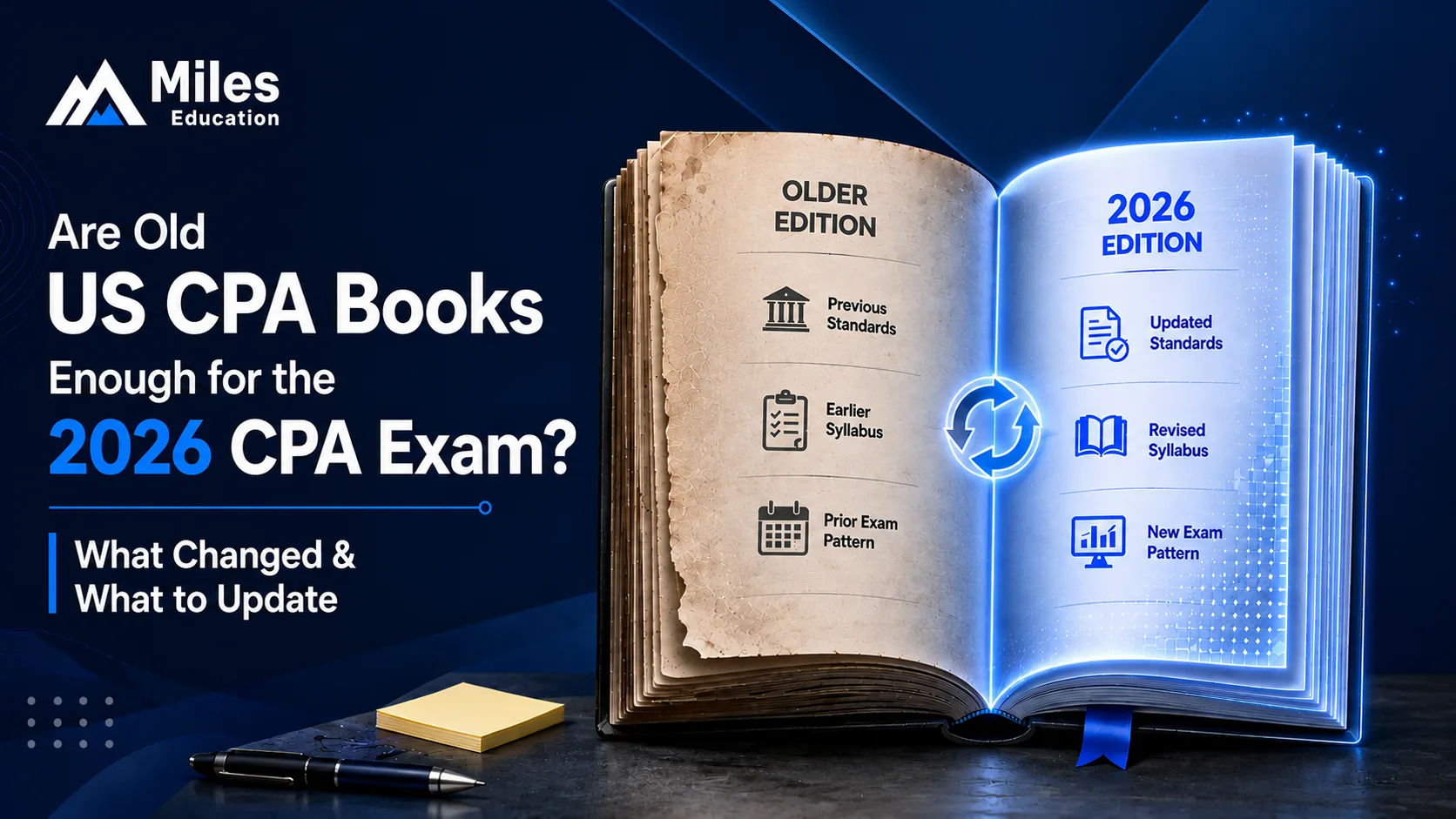
Are Old US CPA Books Enough for the 2026 CPA Exam? CPA
Uttam Pai Umesh
US CPA- Accounting & Finance Expert
•
13 Jul 2026
13 Jul 2026
Share this page
Share to
“ Wondering if old US CPA books are enough for the 2026 CPA Exam? Learn what changed, what to update, and how to prepare with the right study material.
If you're planning to take the US CPA Exam in 2026, you may be wondering whether you can rely on old US CPA books or if it's time to invest in updated resources.
The short answer is not entirely.
While accounting fundamentals remain the same, the CPA Exam has evolved significantly in recent years. The introduction of the CPA Evolution model, greater emphasis on technology, data analytics, and changing business practices mean that older CPA books may not fully prepare you for today's exam.
This guide explains what has changed, which study resources are still relevant, and how to ensure your CPA preparation aligns with the latest CPA exam syllabus.
Why Aren't Older US CPA Books Enough?
The biggest shift came with the CPA Evolution initiative, launched by the American Institute of Certified Public Accountants (AICPA) and the National Association of State Boards of Accountancy (NASBA). The goal was to ensure newly licensed CPAs possess not only strong accounting knowledge but also technology and analytical skills required in modern finance.
As a result, the CPA syllabus now reflects the realities of today's profession.
Older books published before the CPA Evolution changes may lack coverage of:
Data analytics applications
Business technology concepts
Information systems controls
Automation and digital workflows
Updated tax regulations and accounting standards
Recent blueprint changes issued by the AICPA
"The accounting profession is changing rapidly, and newly licensed CPAs must possess both accounting and technology competencies."
- AICPA & NASBA, CPA Evolution Initiative
Set Miles as Your Preferred Source
Make Miles Education your preferred source for CPA & CMA Exam tips, accounting insights, AI tools and industry updates.
What Does the 2026 CPA Exam Cover?
The CPA exam syllabus follows a Core + Discipline model.
Core Sections
Candidates Study
Auditing and Attestation (AUD)
Mandatory
Financial Accounting and Reporting (FAR)
Mandatory
Taxation and Regulation (REG)
Mandatory
Candidates also choose one Discipline section:
Business Analysis and Reporting (BAR)
Information Systems and Controls (ISC)
Tax Compliance and Planning (TCP)
Although every candidate studies the same three Core sections, the Discipline allows specialization based on career goals.
Can You Still Use Old CPA Books?
Yes-but only for selected topics.
Older US CPA books remain valuable for learning accounting principles, journal entries, auditing concepts, financial reporting, and taxation fundamentals. However, relying on them as your primary CPA study material could leave gaps in your preparation.
Still Useful
Needs Updated Material
Accounting basics
CPA Evolution topics
Financial statements
Technology controls
Audit concepts
Data analytics
Tax fundamentals
Latest IRS changes
Cost accounting
New AICPA Blueprints
Ethics concepts
Recent accounting standards
A practical approach is to use older books for conceptual understanding while supplementing them with updated learning resources aligned with the latest exam blueprint.
What Changed in the CPA Syllabus?
The knowledge tested in the exam continues to evolve alongside the accounting profession.
Some of the key changes include:
Greater Focus on Technology
Technology is no longer treated as an optional skill.
Candidates are expected to understand:
IT governance
Cybersecurity basics
Internal controls
Business systems
Risks associated with digital financial reporting
More Data Analytics
Today's accountants interpret data instead of simply recording transactions.
Candidates should understand:
Data visualization
Analytical procedures
Risk assessment using data
Business decision-making through analytics
Updated Accounting Standards
The CPA syllabus also reflects newer accounting and auditing standards issued by relevant standard-setting bodies.
Using outdated CPA study material may result in learning superseded guidance.
How to Choose the Right CPA Study Material
When selecting US CPA study material, check whether it includes:
Coverage of the latest AICPA Blueprints
Regular content updates
Practice questions reflecting current exam trends
Task-Based Simulations (TBS)
Mock exams
Performance tracking
Video lectures and revision support
These features help bridge the gap between theoretical knowledge and exam application.
Signs Your CPA Books Are Outdated
You should consider updating your resources if your books:
Were published before the CPA Evolution model
Do not mention Discipline sections
Lack technology-related topics
Contain outdated accounting standards
Do not include recent Task-Based Simulations
Reference an older exam structure
Even if the concepts remain accurate, outdated books may not prepare you for the way questions are asked today.
Begin with updated US CPA books aligned with the latest blueprint.
Follow a structured study schedule.
Solve multiple-choice questions daily.
Practice Task-Based Simulations regularly.
Revise weak areas using performance analytics.
Stay informed about blueprint updates released by the AICPA.
As management expert Peter Drucker famously said:
"The best way to predict the future is to create it."
For CPA candidates, that means preparing for the exam as it exists today-not as it was several years ago.
Looking Beyond Books
Books remain an important part of exam preparation, but they are no longer sufficient on their own.
Many candidates now supplement traditional textbooks with digital learning platforms, adaptive question banks, mock exams, and AI-powered learning tools to gain a more comprehensive understanding of the material.
Institutions such as Miles Education have also expanded beyond conventional study resources by offering structured CPA learning programs, mentorship, and technology-enabled learning experiences. For learners looking to build practical skills alongside exam preparation, initiatives like CAIRA (Certified AI Readiness for Accountants) introduce accounting professionals to AI applications that are becoming increasingly relevant in modern finance roles. While these programs are separate from the CPA Exam itself, they can help candidates develop skills that complement today's evolving accounting profession.
Conclusion
Old US CPA books still have value for understanding core accounting concepts, but they should no longer be your only resource for the 2026 CPA Exam.
The updated CPA exam syllabus places greater emphasis on technology, analytics, and real-world application. Combining foundational CPA books with current US CPA study material, practice questions, simulations, and updated learning resources gives you the best chance of success.
As the accounting profession continues to evolve, staying current isn't just beneficial for passing the exam-it's essential for building a future-ready career.
FAQs
1. Are old US CPA books enough for the 2026 CPA Exam?
They are useful for learning core concepts but should be supplemented with updated study material that reflects the latest AICPA Blueprints and CPA Evolution changes.
2. Has the CPA syllabus changed for 2026?
The 2026 exam continues to follow the CPA Evolution model introduced in 2024, with ongoing updates to reflect current accounting standards and professional practices.
3. What is the latest CPA exam syllabus?
The exam includes three Core sections-AUD, FAR, and REG-and one Discipline section: BAR, ISC, or TCP.
4. What is the best CPA study material?
The best resources include updated textbooks, question banks, Task-Based Simulations, mock exams, and learning platforms that align with the latest AICPA Blueprints.
5. Can I pass the CPA Exam using only books?
Books provide a strong foundation, but most successful candidates also use practice questions, simulations, and mock exams to prepare effectively.
Uttam Pai Umesh
US CPA- Accounting & Finance Expert
Uttam is a finance professional with over seven years of experience across accounting, auditing, and finance, now teaching at the point where those disciplines meet AI. He teaches accountants how to put AI tools to work in the tasks they already do, and builds learner-focused content that turns complex concepts into steps a student can apply the same week, helping professionals move ahead in their careers with confidence.